
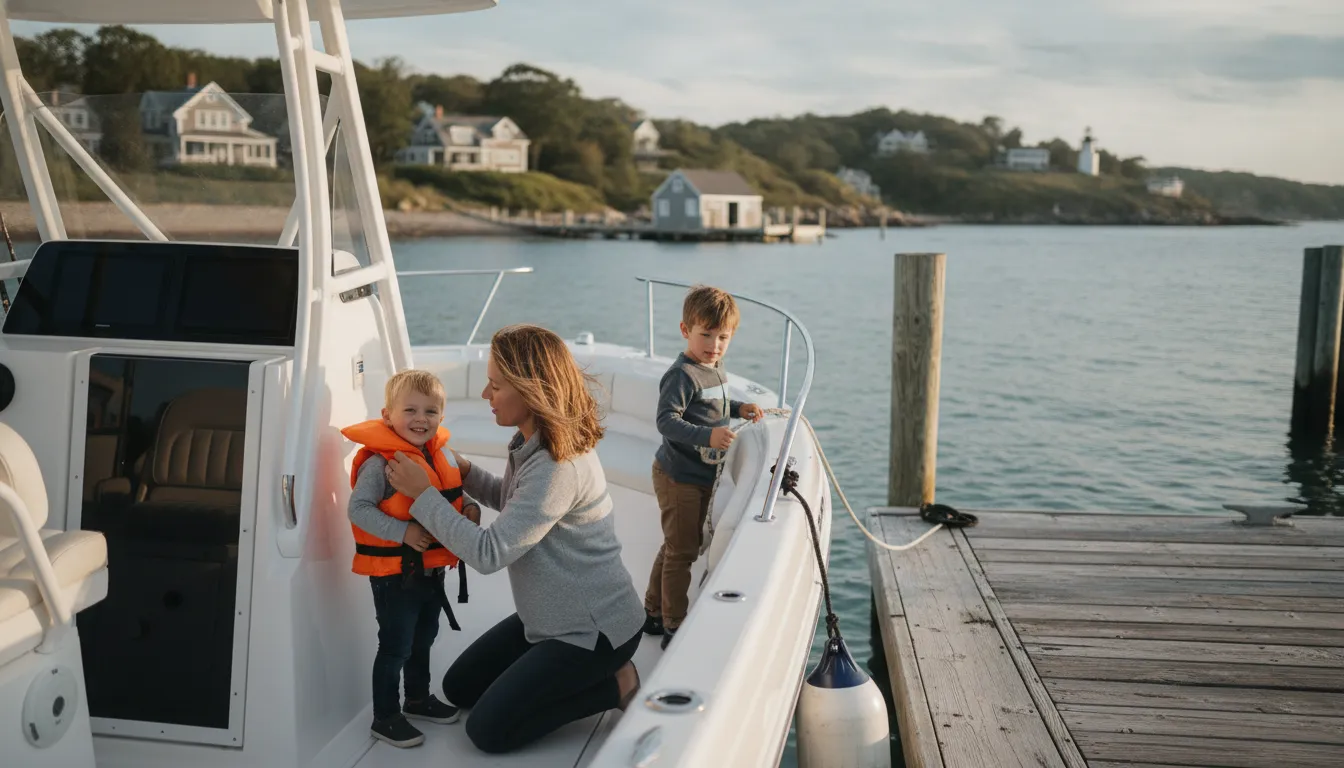
Boating with children in Massachusetts starts with a simple preparation step: know when a personal flotation device, or PFD, is required. Make wearing one part of your routine. The state rule is age-specific, but responsible families should also consider water temperature, a child’s swimming ability, and the conditions of the trip. See the Massachusetts boating safety guide.
Book a tour to learn more about family boating in Massachusetts.
Under Massachusetts law, children under 12 must wear an approved life jacket while a vessel is underway. The state also recommends wearing a life jacket every time you are on the water. So families should confirm the current guidance and choose a properly fitted PFD for each child. This overview explains the life jacket laws for children massachusetts boaters need to understand.
That legal starting point is only one part of a safe outing. From Boston and the North Shore to Danvers and Gloucester, the right habits include checking equipment before departure, understanding what underway means, and making sure children know how and when to wear their PFDs.
What Do Life Jacket Laws for Children in Massachusetts Require?
Massachusetts requires children under 12 to wear an approved life jacket when the vessel is underway. In practical terms, that means the child should have a properly selected, wearable personal flotation device (PFD) on before the boat begins moving and keep it on while the vessel is in motion. The rule applies to children under 12, not children under 13, so parents should use the correct age threshold when planning a family boating trip.
The Massachusetts Office of Energy and Environmental Affairs also recommends wearing a life jacket every time you are on the water, regardless of age. That recommendation is broader than the minimum legal requirement. A child who has reached age 12 may no longer fall under the under-12 rule. But wearing a life jacket remains a sensible family standard, especially when conditions change or someone is boating in an unfamiliar area. Read the current guidance from Mass.gov’s boating safety information before heading out.
What does “underway” mean for a child on board?
For this rule, the key situation is a vessel that is underway, rather than simply a boat with passengers aboard at the dock. Children under 12 should be wearing their approved, wearable PFD whenever they are above deck on a vessel that is moving or otherwise underway. Making the life jacket part of the pre-departure routine removes uncertainty: check the fit. Secure every fastening, and confirm that the child is wearing it before leaving the dock.
This matters because a fall overboard can happen without much warning. Massachusetts cautions that cold-water immersion causes many boating-related fatalities. A sudden fall into cold water can trigger an involuntary gasp and water ingestion, while hypothermia can develop within minutes. Those risks are reasons to treat the legal requirement as a baseline, not as a signal that a life jacket is unnecessary whenever the law does not specifically require one.
Q: Does Massachusetts require every child to wear a life jacket all the time?
A: Massachusetts specifically requires children under 12 to wear an approved life jacket when the vessel is underway. The state recommends wearing a life jacket every time you are on the water, which is a stronger safety practice for children and adults alike. Because boating rules and guidance can change, confirm the current requirements on Mass.gov before your trip.
Parents also have a separate responsibility when children are operating a motorboat. Massachusetts law does not allow a person under 12 to operate a motorboat unless they are accompanied on board and directly supervised by a competent person who is at least 18. Life jacket compliance and responsible supervision work together, but neither should be treated as a substitute for the other.
What Type of Life Jacket Should a Child Wear on a Massachusetts Boat?
For a child under 12, choose a properly fitting, USCG-approved wearable personal flotation device, or PFD. Have the child wear it whenever they are above deck while the vessel is underway. A PFD is designed to help keep a person afloat. The approval matters because it confirms the device meets the applicable safety standard for its intended use.
Massachusetts guidance identifies a USCG-approved wearable PFD, or a Type I, Type II. Type III, or Type V PFD, as an option for children under 12 in that situation. The right choice depends on the child’s size, the device’s label and instructions, and whether the child can wear it comfortably and securely. Never choose a vest based only on color or appearance. Check the label and follow the manufacturer’s fit guidance. Massachusetts PFD guidance provides the referenced list of approved wearable options.
What does properly fitting mean?
A properly fitting child PFD should be made for that child’s current size and should sit securely without creating obvious gaps or slipping out of position. Fasten every closure as directed, then check the fit before leaving the dock. The child should be able to move, sit and take part in normal boating activities without the vest becoming loose. If the device is uncomfortable, damaged or difficult to secure, select another approved option rather than treating it as ready for use.
Is a Type IV device a child’s life jacket?
No. A throwable Type IV device is different from a child-worn PFD. It is flotation equipment intended to be thrown to someone in the water, not worn as the child’s life jacket. Massachusetts guidance says one USCG-approved throwable Type IV device must be onboard vessels 16 feet or longer. That equipment requirement is in addition to the PFD requirement; a throwable cushion or ring does not replace a wearable PFD for a child who must wear one.
- Check that the PFD is USCG-approved and intended for the child’s current size.
- Fasten it according to the label and inspect it for damage before departure.
- Make sure the child wears the PFD above deck while the boat is underway.
- Keep any required Type IV device accessible, but do not count it as the child’s wearable life jacket.
Massachusetts recommends wearing a life jacket every time you are on the water. For current requirements and definitions, review the state’s boating safety guidance before your next trip.
| Device | How it is used | Does it replace a child-worn PFD? |
|---|---|---|
| Wearable PFD | Worn by the child when required | No, it is the required child flotation device |
| Throwable Type IV device | Thrown to someone in the water | No, it is separate equipment |
When Must Children Wear Life Jackets on a Moving Boat?
In Massachusetts, children under 12 must wear an approved life jacket when the vessel is underway. In practical terms, that means the boat is moving or preparing to navigate, rather than secured at the dock. The state’s boating safety guidance identifies this as a requirement for youth under 12. While also recommending that everyone wear a life jacket every time they are on the water. Review the current Mass.gov boating safety guidance before your next outing.
The rule is about the child’s age and the boat’s status. It is not an under-13 rule, and it should not be treated as permission for older children to go without a PFD. Conditions can change quickly, especially around Massachusetts harbors, rivers, and open water. A parent or guardian can set a family standard that goes beyond the legal minimum. Such as wearing a properly fitted PFD from the moment a child steps aboard until the boat is secured again.
What should families do before the boat leaves?
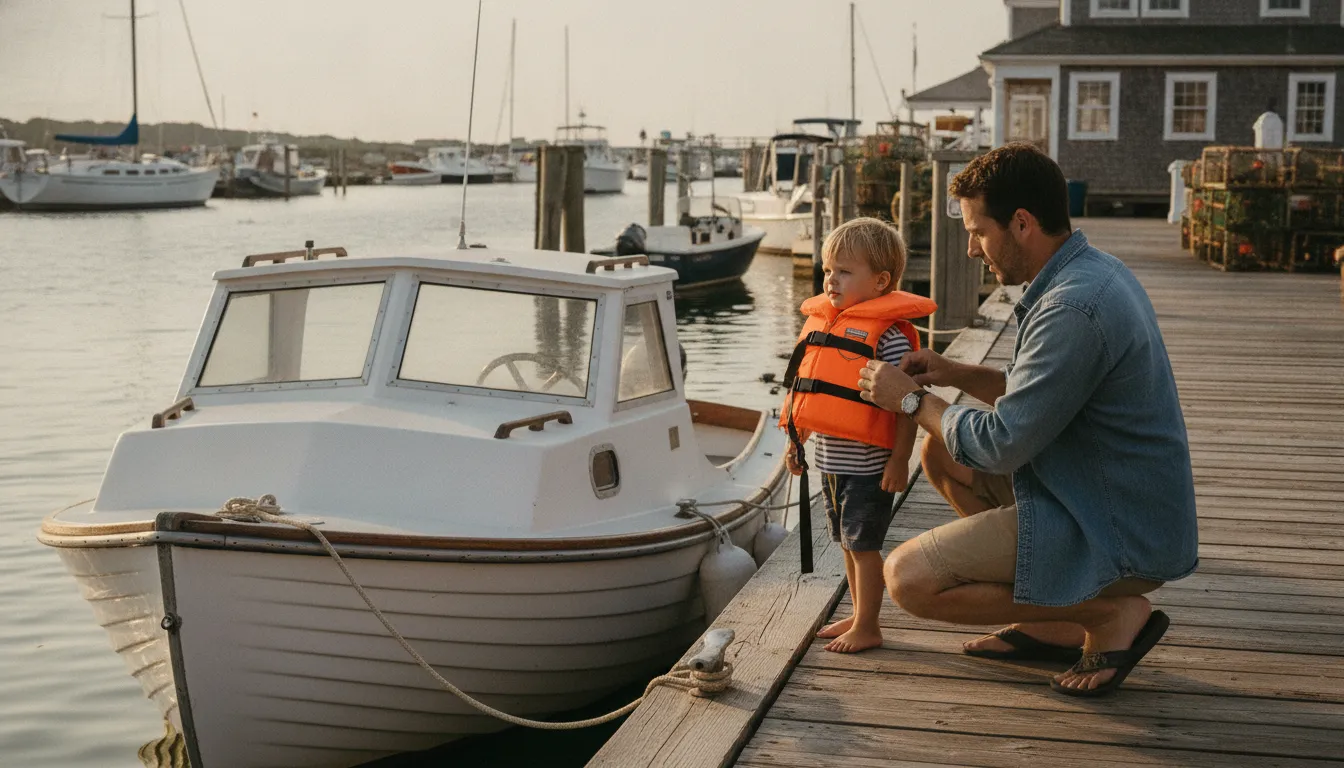
Make the life-jacket check part of getting underway, just like securing loose gear. Each child should have a USCG-approved, wearable PFD that fits properly and is in good condition. Help children put it on before the engine starts, fasten every closure, and check that it stays secure when they move, sit, or reach. Explain the routine in a calm, matter-of-fact way so wearing a PFD feels normal rather than alarming.
Why does cold water matter?
Massachusetts boating often begins or continues during cool-water conditions. Mass.gov notes that cold-water immersion causes many boating-related fatalities. A sudden fall can trigger an involuntary gasp and water ingestion, and hypothermia can develop within minutes. Those facts are not meant to frighten children. They explain why a PFD matters before an unexpected slip, even when the water looks calm and the trip is short.
Once the boat is moving, keep the rule visible through consistent adult example. Older children and adults may not fall under the same under-12 requirement. But wearing a PFD remains a sensible choice whenever the boat, weather, or water conditions make a fall more likely.
How Can Massachusetts Families Choose and Check a Child’s PFD?
Choosing a child’s personal flotation device, or PFD, is a practical safety decision. Massachusetts guidance says a child’s life jacket should be USCG approved, in good condition, and properly fitted. Those are safety standards to use when preparing for a trip. Not a new Massachusetts legal requirement or a guarantee that a child will be safe in every situation.
Start with the label. For children under 12, Massachusetts requires an approved wearable PFD when the vessel is underway. The state study guidance identifies USCG-approved wearable PFDs and Type I, II, III, or V options for this purpose. Read the label on the specific device rather than relying on appearance, color, or a retailer’s general description.
What should parents check for fit and comfort?
- Correct child fit: Follow the manufacturer’s child-fit directions on the label. Never guess from age or appearance alone, and never use an adult-sized vest for a child.
- Secure fasteners: Close every buckle, zipper, and adjustment strap. The vest should feel secure without restricting normal breathing or movement.
- Comfort during movement: Have the child wear it while walking, sitting, and reaching. A child who can move comfortably is more likely to keep the PFD on throughout the outing.
- Condition: Look for torn fabric, damaged straps, broken buckles, separated seams, or signs that the flotation material has deteriorated. Replace a PFD when its condition is questionable.
- Wearability: Confirm that it is a wearable PFD designed for the child’s use. A throwable Type IV device, where required for certain vessels, is not a substitute for a child’s wearable life jacket.
What belongs in a pre-launch check?
Before leaving the dock, put the child’s PFD on and check each closure. Make sure it is not trapped under a seat or buried with other gear, and confirm that the child knows when it must stay on. Recheck the fit after clothing changes or as the child grows. Massachusetts recommends wearing a life jacket every time you are on the water, so many families choose to make the check routine for everyone aboard.
For current requirements and any situation involving unusual equipment or conditions, confirm the rules with Massachusetts boating safety guidance.
What Other Massachusetts Boating Rules Should Parents Know?
The child life-jacket requirement is only one part of Massachusetts boating safety law. Parents should also understand who may operate a motorboat, when direct supervision is required, and when an operator needs boating education credentials. These rules are separate from the age-based PFD requirement, so a child may need both an approved life jacket and an appropriately qualified adult operator. For the broader rules, review Massachusetts boating safety law.
Who may operate a motorboat?
Massachusetts law says a person under 12 may not operate a motorboat unless they are aboard and directly supervised by a competent person who is at least 18 years old. Review the Massachusetts boating law summary before allowing a child to take the controls, since supervision and operator requirements are different questions from whether a child must wear a PFD.
Personal watercraft have a separate age rule. Operators must be at least 16 years old. Massachusetts also requires motorboat and personal watercraft operators to carry proof of completion of an approved boating education course while on the water. That documentation requirement is worth checking before a family trip, particularly when more than one adult may operate the boat.
What changed for boating certificates in 2026?
Mass.gov currently states that, beginning April 1, 2026, a valid boater safety certificate is required to operate motorboats and personal watercraft in Massachusetts. The state guidance says operators born after January 1, 1989, were expected to obtain the certificate by April 1, 2026. It also states that operators born on or before January 1, 1989, must obtain one before April 1, 2028. Because certificate rules and implementation dates can change, confirm the current requirement directly in the Massachusetts boating safety guidance before heading out.
Families looking for a structured starting point can review Massachusetts boating certification resources. Training can build practical confidence, but it does not replace an adult’s supervision, a properly fitted PFD, or checking current state requirements. For families focused on life jacket laws for children Massachusetts, treat operator education as an additional safety layer, not a substitute for the child-wear rule.
How Does Carefree Boat Club Support Safer Family Boating?
Families in Boston, Danvers, and Gloucester can benefit from a boating routine that combines preparation, instruction, and attention to the boat’s safety equipment. Carefree Boat Club supports that routine through professional safety-equipment training and structured boat inspections. These practices can help members understand what to check before leaving the dock. But they do not guarantee safety or replace a parent’s judgment, supervision, or responsibility to follow current Massachusetts law.
Safety-equipment training covers more than simply locating life jackets. Members learn where onboard safety gear is stored, how to use it, how emergency equipment is deployed, and how to verify that equipment is maintained. Training also addresses the legal requirements that apply to the trip. Families should still confirm current requirements, including on-the-water training guidance, against official Massachusetts resources before heading out.
Each week, Carefree’s 50-point inspection process verifies that life vests are available for all capacity positions. The inspection also reviews other equipment and systems, including fire extinguishers, flares, first aid kits, emergency signaling devices, anchors, lines, navigation equipment, and mechanical components. Having these checks built into the operating process gives families a practical starting point for their own pre-departure review.
The club’s 12-module curriculum adds broader preparation for real situations on the water. Lessons include identifying safety equipment, using a VHF radio and making emergency calls, navigating local waterways, observing no-wake zones, responding to a person overboard, suppressing a fire, handling a boat taking on water, and responding to a medical emergency. Boating 101 also covers weather checks, navigation fundamentals, launching, on-water procedures, and docking.
For a family learning together, that structure can build confidence without encouraging complacency. Parents remain responsible for deciding whether conditions are appropriate, ensuring children wear properly fitted approved life jackets when required, and supervising everyone throughout the outing. Training and inspections support good preparation; they are not a substitute for current law, careful choices, or active parental responsibility.
Frequently Asked Questions
How old do you have to be to not wear a life jacket in Massachusetts?
Massachusetts requires children under 12 to wear an approved life jacket when a vessel is underway. The state also recommends wearing a life jacket every time you are on the water, regardless of age. Read the current guidance from Mass.gov before your trip.
Does a 10-year-old have to wear a life jacket on a boat?
Yes. A 10-year-old is under the Massachusetts age threshold, so the child must wear an approved, properly fitting life jacket when the vessel is underway. The rule applies while the child is above deck, and a wearable PFD should be selected for the child’s size and activity.
Can a 12-year-old wear an inflatable life jacket?
An inflatable PFD may be suitable only when it is USCG-approved for that wearer and the activity, and the manufacturer’s instructions allow its use. Check the approval label and fit before relying on it. For younger children, use an approved wearable PFD designed for the child’s size instead of assuming every inflatable model is appropriate.
What are the changes in Massachusetts boating law in 2026?
Beginning April 1, 2026, Massachusetts requires a valid boater safety certificate to operate motorboats and personal watercraft. Operators born after January 1, 1989, have until that date to obtain the certificate, with penalties delayed until September 1, 2026. Because rules and enforcement details can change, confirm the current requirements with Mass.gov.
Ready to Explore Family Boating in Massachusetts?
A tour can help your family understand how Carefree Boat Club membership fits into your boating plans, from getting on the water to building confidence with the basics.