

Boston Harbor can look inviting from shore, but a rewarding outing depends on more than a clear forecast. Wind, visibility, cold water, commercial traffic, shoals, channels, and changing conditions all shape how you plan a day on the harbor. Start by deciding what kind of experience you want, then match your route, safety preparation, and access model to that goal.
Contact Carefree Boat Club to ask about Boston Harbor boating access.
Planning sailing Boston Harbor means checking the weather, reviewing the chart and navigation aids, preparing for cold-water conditions, and choosing an access option that fits your experience. Carefree Boat Club of Massachusetts is transparent about its local offering: the Boston club provides access to maintained powerboats, not sailboats or sailing instruction.
The right preparation makes the difference between simply reaching the water and enjoying it responsibly. Before thinking about destinations or membership options, review the practical checks that should shape every Boston Harbor plan.
What should you check before sailing Boston Harbor?
Start with the forecast, then look beyond the headline conditions. Boston Harbor can feel manageable near shore while wind, visibility, and wave conditions become less comfortable around open water and the islands. Weather conditions in the Boston Harbor Islands can change rapidly, so dress in layers and plan for the temperature to feel different once you are underway. A warm afternoon on land is not a reason to skip a jacket or an extra layer aboard.
Check the marine forecast shortly before departure and again before committing to a longer crossing. Pay attention to wind direction, wave conditions, visibility, and any thunderstorm or fog concerns. Do not treat a forecast as a route guarantee. Conditions can change, and a sensible plan includes turning back, shortening the outing, or choosing a more protected destination if the actual day does not match the plan.
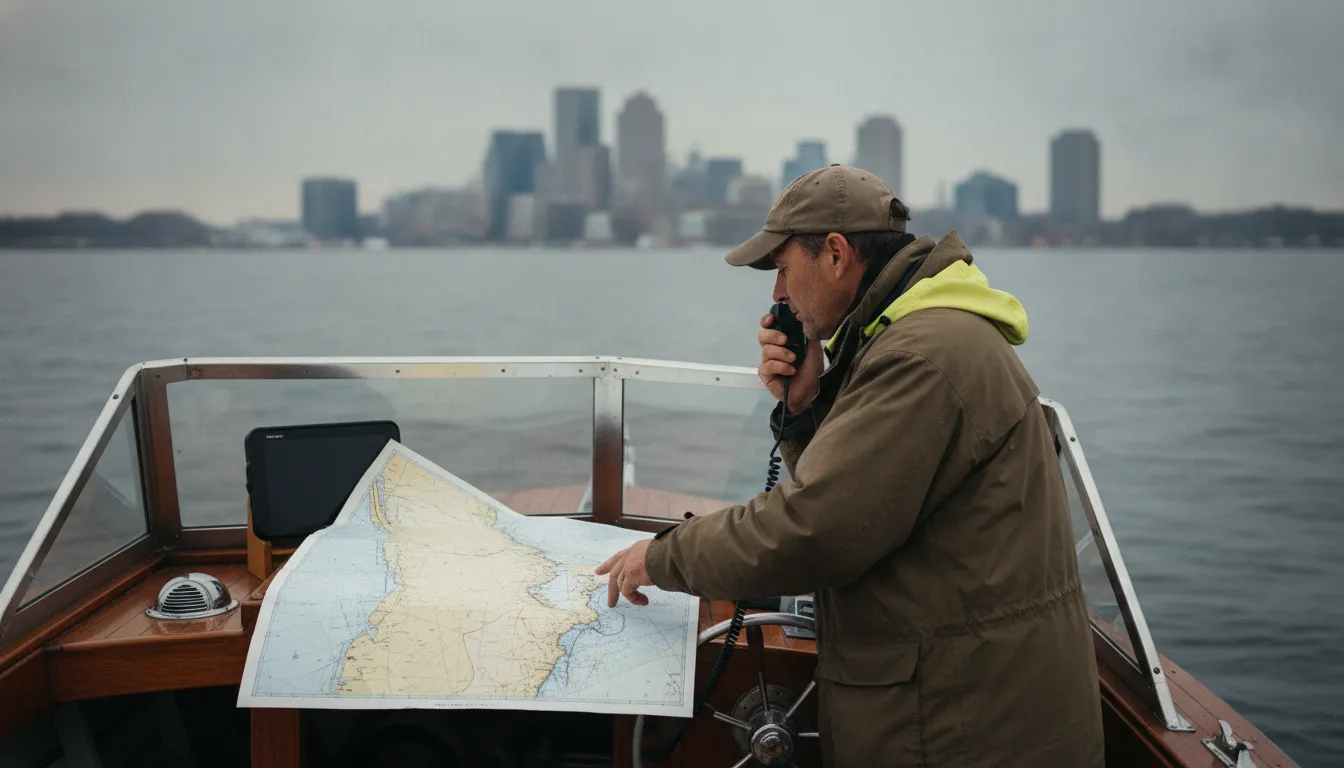
Next, study the chart for the specific route rather than relying only on a familiar landmark. The approaches to Boston Harbor contain islands, shoals, and broken ground. In the northeastern approach, islands and shoals extend several miles from the entrance, with dredged channels leading between the obstructions. The southeastern approach also includes broken ground extending offshore. Lights and buoys mark principal dangers, but navigation aids work best when you have already reviewed the chart and understand what they are marking. The NOAA Coast Pilot is a useful reference for this local context.
For a sailboat, wind direction and strength affect both your intended course and your ability to make progress against the wind. Leave room in the plan for tacking, changing sail, or returning earlier than expected. A powerboat outing has a different planning profile, but the same hazards still matter: shoals, channels, buoys, changing visibility, and traffic all deserve attention. Do not assume a route that works comfortably under power will feel equally straightforward under sail.
Before leaving, tell everyone the general route and the decision point at which you will turn around. Review where you can pause or seek shelter, and make sure the group understands that the destination is flexible. It is also worth reviewing New England boating etiquette, especially when your route brings you near other boats, docks, or busy harbor areas.
The best planning takeaway is simple: check the current marine forecast and review the chart for hazards and marked channels. Dress for changing conditions. Choose a route with enough flexibility to turn a good day on Boston Harbor into a shorter but safer one when conditions warrant.
How can you prepare for a safe Boston Harbor outing?
Good preparation matters whether you are planning a sailing trip or a powerboat outing. Boston Harbor combines open water, changing conditions, commercial traffic, and islands where help may take longer to arrive than it would on the mainland. Build your safety plan before leaving the dock, and make sure everyone aboard understands the plan.
What safety equipment should everyone use?
Wear a properly fitted, US Coast Guard-approved life jacket whenever you are on the water. Massachusetts recommends wearing one every time, because an accident can happen too quickly to retrieve a jacket that is stowed below deck. A life jacket helps you stay afloat, but it does not prevent hypothermia. Cold-water immersion is a major boating hazard, and Massachusetts cautions that water can remain dangerously cold even when spring air feels warm. After a capsize or fall overboard, hypothermia can develop within minutes.
Dress in layers and plan for conditions to change quickly. Keep a practical emergency kit aboard, including communication equipment, a first-aid kit, a flashlight, and other required safety gear. Review the Massachusetts boating safety requirements before your trip, especially if you are operating a motorboat and need to understand current education and equipment obligations.
How should you plan for an emergency?
Share your intended route, expected return time, and passenger list with someone who is staying ashore. This is especially important when visiting Boston Harbor Islands, where emergency response can take considerably longer than for a similar distance on the mainland. Keep your marine radio accessible and know how to use it. For an emergency on the water, the National Park Service directs boaters to contact the US Coast Guard on VHF Channel 16.
Before departure, identify the boat’s capacity and account for people, equipment, and changing water conditions. Do not overload the vessel. Operate at a speed appropriate for visibility, weather, traffic, and other hazards, rather than treating a posted maximum as a target. Massachusetts prohibits excessive speed in hazardous conditions and operating beyond a boat’s reasonable capacity.
What should passengers remember?
Keep the operator sober. Massachusetts prohibits operating any vessel under the influence of alcohol or drugs, and impairment can affect judgment long before an emergency becomes obvious. Assign a responsible person to monitor surroundings, passengers, and communications so the operator can focus on navigation. These habits support a safer day on the harbor without assuming that weather, route, or response time will always cooperate.
How should you plan a Boston Harbor route?
A good route begins with the chart, not with a promise about how far you can travel or how many islands you can visit. Boston Harbor combines open water, working traffic lanes, narrow approaches, islands, shoals, and several major tributaries. Build a primary plan, then identify shorter alternatives that still make sense if wind, visibility, traffic, or the crew’s comfort changes.
Start by reviewing current nautical charts and the limits of the Boston Traffic Separation Scheme. The Coast Pilot describes inbound and outbound one-way lanes, a defined separation zone, and precautionary areas in the harbor approach. These lanes are intended to help prevent collisions, but they do not remove the need for a proper lookout or careful crossing decisions. Treat commercial traffic as a central route-planning consideration, not an obstacle to improvise around at the last minute. Read the NOAA Coast Pilot guidance for Boston Harbor approaches.
Use the chart to identify the marked channel that fits your intended approach, along with nearby buoys, lights, shoals, and shallow areas. The northeastern approach includes islands and shoals extending several miles from the entrance, with dredged channels leading between obstructions. The southeastern approach also includes broken ground extending offshore. Navigation aids mark principal dangers, but they work with, rather than replace, your chart and situational awareness.
Next, decide how islands and tributaries fit into the day. Boston Harbor’s geography includes the Charles, Chelsea, Mystic, and Weymouth Fore Rivers, as well as Dorchester and Hingham Bays. A route that looks simple on a screen can become more demanding when it includes a narrow entrance, a busy crossing, or a long return leg. Leave time and distance in reserve instead of making the final destination the only measure of success.
Finally, plan for environmental rules as well as navigation. Massachusetts coastal waters covered by the Coast Pilot include a no-discharge zone extending about three miles offshore. And sewage discharge from vessels is prohibited there, whether treated or untreated. Confirm your vessel’s systems and operating plan before departure. The safest approach to sailing Boston Harbor is flexible: check conditions before leaving, communicate the route to everyone aboard. And be willing to shorten or change it when the real harbor does not match the forecast.
Which access model fits your Boston Harbor plans?
The best way to spend time on Boston Harbor depends on what you want to learn, manage, and repeat. A guided sailing experience can be a good introduction when your priority is seeing the harbor without planning the route or handling the boat. Ownership offers the most control, but it also brings responsibility for maintenance, storage, safety equipment, seasonal preparation, and operating decisions.
Renting can suit an occasional outing when you are comfortable with the boat and the rental process. A boat club occupies a middle ground: members use a maintained boat without taking on every responsibility of ownership. The tradeoff is that access follows the club’s reservation and operating policies, and the available boats may not match every type of boating activity.
| Access model | Usually fits best when you want to… | Important consideration |
|---|---|---|
| Guided sailing experience | Enjoy time under sail while an experienced operator manages the boat. | You have less control over the route, timing, and hands-on learning. |
| Own a sailboat | Sail regularly and choose your boat, schedule, and destinations. | You take responsibility for ownership costs, upkeep, storage, and operation. |
| Rent a boat | Plan occasional independent outings without a long-term commitment. | Boat type, booking rules, orientation, and availability vary by provider. |
| Join a boat club | Use club boats repeatedly while avoiding individual boat ownership. | Access depends on membership terms, reservations, training, and the club’s fleet. |
One distinction matters for readers researching sailing Boston Harbor: Carefree Boat Club of Massachusetts is not a sailing school or sailboat membership. Its local membership is focused on access to maintained powerboats, along with practical training for safe operation, navigation, and local waterways. That can be a strong fit for families and boaters who want independent harbor trips by powerboat. But it is not a substitute for learning to sail or booking time on a sailboat.
Before choosing, write down your primary activity, how often you expect to go, and how much responsibility you want between outings. Then compare boating access models and confirm that the boat type and training approach match your Boston Harbor plans.
What does Carefree offer for powerboat access near Boston Harbor?
For readers searching for sailing Boston Harbor, it is important to understand what Carefree Boat Club of Massachusetts actually provides. The local club is powerboat-focused. It does not provide sailboats or sailing instruction, so it is not a substitute for a traditional sailing school or a sailboat rental. Instead, it offers a practical way to get on the water in a club powerboat without taking on the responsibilities of ownership.
What can members expect from the Boston location?
Carefree’s Boston base is at Boston Harbor Shipyard & Marina in East Boston. From there, boaters can plan outings on Boston Harbor and explore the surrounding harbor environment. Including the Harbor Islands, while enjoying the perspective that comes from being on the water. The location is especially relevant for Boston-area residents who want local access without storing, maintaining, and managing a privately owned boat.
The local fleet includes powerboat models such as Sailfish, SeaFox, Cobia, and Bennington. Despite its name, Sailfish is a powerboat model, not a sailboat. You can review the boats suited to harbor trips to see the types of outings the fleet is designed to support. The right fit may include relaxed harbor cruising, family time on the water, or exploring local destinations, depending on the boat and the day’s plan.
Newer boaters are not expected to learn everything alone. Club training focuses on operating the club boats, navigation, local waterways, channel awareness, safety practices, and related skills such as using a chart plotter or VHF radio. This is practical boating education, not sailing instruction. Learn more about the club’s on-water training before deciding whether this access model matches your experience and goals.
Carefree can also suit boaters who want more flexibility than a single local outing. Members receive reciprocal access at more than 150 participating Carefree locations, subject to the applicable location and reservation process. That broader network can be useful for people who boat in multiple regions, while the East Boston base provides a clear local starting point. Explore Boston Harbor boating access for more information about the Massachusetts club’s local setting.
Frequently Asked Questions
Can you sail in Boston Harbor?
Yes. Recreational sailors can reach some Boston Harbor Islands independently, and visitors can also use ferries or water taxis depending on the destination and schedule. Plan around your experience, vessel, weather, route, and access to safe moorings. Boston Harbor has marked channels, shoals, islands, and active commercial traffic, so review current charts and marine conditions before departure.
What should I wear for sailing Boston Harbor?
Dress in layers, even when the forecast looks comfortable on shore. Weather conditions around the Boston Harbor Islands can change rapidly, and spring water temperatures may remain dangerously cold. Bring protection from wind and spray, plus clothing that will keep you warm if you are wet. The National Park Service specifically advises visitors to dress in layers. Learn more about Boston Harbor Islands safety.
What safety equipment should every passenger have?
Provide a properly fitted, US Coast Guard-approved wearable personal flotation device for every person aboard. Massachusetts recommends wearing a life jacket every time you are on the water because an accident can happen too quickly to retrieve one from storage. Cold-water immersion can become life-threatening quickly, so check the boat’s radio, navigation equipment, lights, first-aid supplies, and anchor before leaving.
Does Carefree offer sailboats or sailing instruction?
No. Carefree Boat Club is powerboat-focused and does not provide sailboats or sailing instruction. Its Massachusetts offering is designed for members who want access to powerboats, practical on-water training for those boats, and boating without owning a vessel. If your goal is specifically learning to sail or booking a sailboat, choose an access option that explicitly provides those services.
Contact Carefree Boat Club to ask whether powerboat membership fits your Boston Harbor plans.
Ready to plan your Boston Harbor boating day?
Once you understand the weather, route, and safety considerations, the next step is choosing access that fits the way you want to spend time on the water. If you are interested in Carefree Boat Club membership and powerboat access near Boston Harbor, our team can help explain whether the club model matches your plans.
Contact us to ask about Carefree Boat Club membership and powerboat access near Boston Harbor.
https://addlinks.pro/ftzS0