
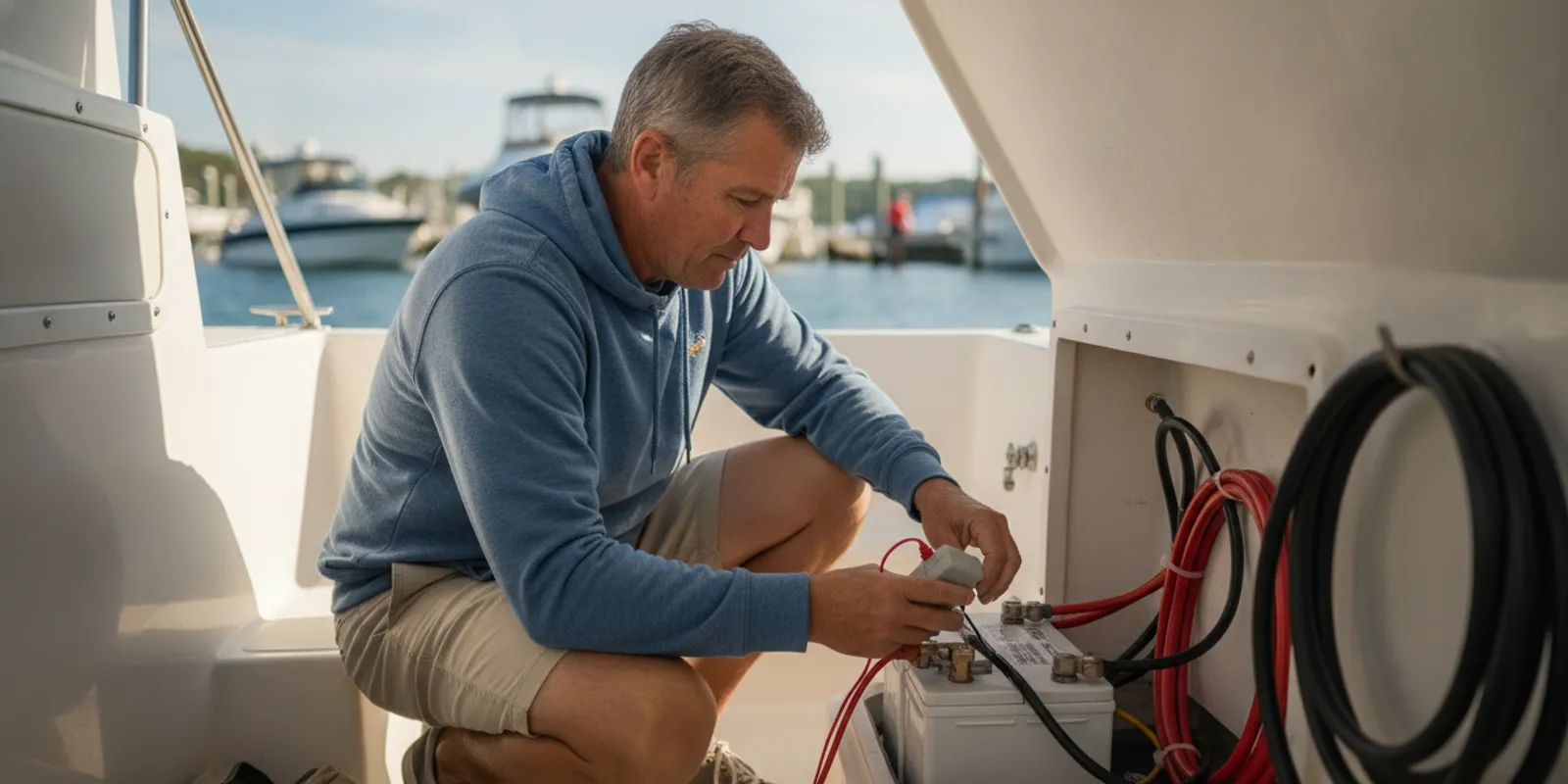
Reliable boat battery maintenance starts with a few careful habits: inspect the battery and connections, use charging equipment made for its chemistry, and follow the manufacturer’s storage instructions. Those steps help you spot trouble before a day on the water. Whether you are new to boating or have years of experience, make the battery check part of your regular pre-departure routine.
Schedule a tour and talk with our team
Why does boat battery maintenance matter?
A marine battery supports more than starting the engine. Depending on the boat and its electrical setup, it may also supply power to navigation lights, electronics, pumps, and other equipment. A weak, damaged, or poorly connected battery can affect those systems. It can also leave you troubleshooting at the dock instead of getting underway.
Regular checks are useful because problems can be gradual. A loose connection, a buildup of corrosion, or a battery that has not been recharged properly may not be obvious until you need dependable power. A simple inspection does not guarantee that a battery will never fail, but it can help you notice visible changes and respond early.
Battery care is one part of being prepared. Review the boat’s safety gear and departure routine as well; our Boating 101 guide is a useful starting point if you are learning the basics. For Massachusetts-specific rules and requirements, see the Massachusetts boating safety laws guide.
What should you identify before working on a boat battery?
Start by identifying the battery type and reading its label and owner’s manual. Marine systems may use flooded lead-acid, AGM, or lithium batteries, among other designs. They do not all share the same charging requirements or care instructions. Do not assume that a charger setting, inspection step, or storage recommendation for one chemistry is right for another.
Battery labels and terminology can be confusing, so confirm details rather than relying on a familiar-looking case or terminal layout. Flooded lead-acid batteries may have service instructions that do not apply to sealed AGM or lithium models. Some battery systems also combine batteries or use a battery management system. The maker’s manual should tell you what the indicator lights mean, whether the battery may be charged while installed, and what to do if the system reports a fault. Keep those directions with the boat instead of relying on memory.
Also note whether the battery is used for engine starting, house loads, or both. A starting battery and a deep-cycle battery are designed for different patterns of use, and not every vessel uses the same arrangement. This distinction helps you describe symptoms accurately when asking for help. Do not rewire or replace a battery based on a general online recommendation; confirm that any replacement matches the boat’s electrical requirements.
Locate the battery switch and learn what it controls. If you are unsure how the boat’s electrical system is arranged, ask a qualified marine technician or the boat’s responsible operator before disconnecting anything. Some systems have more than one battery or a specific switching sequence. Guessing can interrupt power to equipment or create a hazard.
- Read the battery and charger labels. Note the chemistry, model, and any warnings.
- Find the manual for the battery and the boat’s electrical system.
- Check whether the battery is securely held in place and whether the compartment is clean and dry.
- Know how to shut off electrical loads before inspection or charging.
If a label is unreadable, a case is damaged, or you cannot identify the system, stop and get qualified help rather than improvising. Personal safety comes first.
How can you inspect the battery and connections?
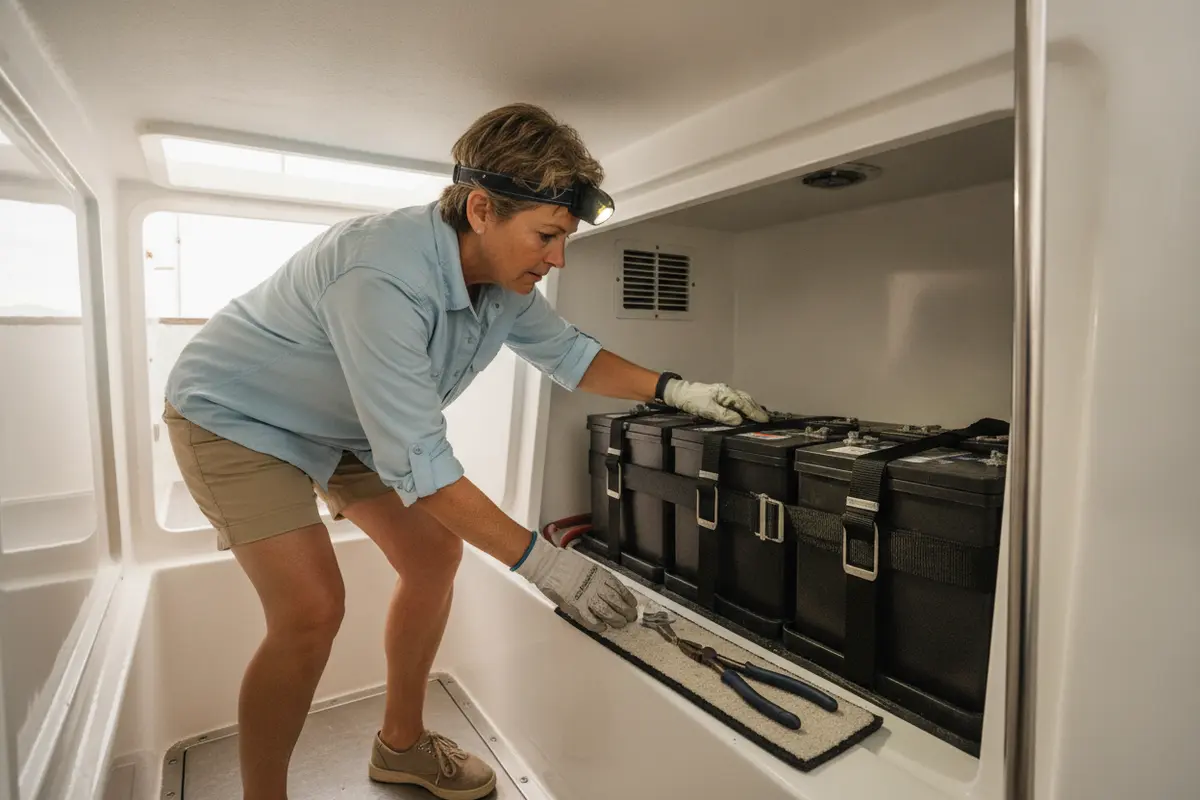
Look over the battery before each boating day, and do a closer inspection at intervals recommended by its manufacturer. Keep the area well lit. Look for cracks, bulging, leaks, unusual residue, damaged insulation, loose cables, and signs that the battery has shifted. A battery that moves in its tray can strain its connections and should be secured correctly before use.
Examine the terminals and cable ends for corrosion or a poor fit. Connections should be secure, with no exposed or frayed cable strands. Do not touch a damaged or leaking battery, and do not try to tighten or clean a connection while the system is energized. If you are not sure how to isolate power safely, leave the work to a qualified person.
Pay attention to changes over time. If the engine turns over more slowly than usual, electronics behave inconsistently, or the battery repeatedly loses charge, note when it happens and what was running. Those clues can help a marine technician distinguish a battery problem from a charging-system issue, parasitic draw, or another electrical fault.
Visual checks are not a substitute for proper testing. If you suspect a weak battery, use an appropriate test performed according to the battery maker’s instructions or ask a technician to assess it. Avoid relying on one reading taken under unknown conditions to decide that a battery is healthy.
A consistent inspection is more useful than a rushed glance. Use a short repeatable sequence:
- Make sure the boat is secured and the electrical system is in the state required for inspection.
- Look at the case, mounting, surrounding space, and cables before touching anything.
- Check for visible corrosion or looseness, but do not adjust a live connection.
- Confirm that protective covers are present where required and that nothing conductive is resting on or near the terminals.
- Record a concern and arrange assessment rather than returning a questionable battery to service without advice.
A simple log can show whether a symptom is new or recurring. Write down the date, whether the battery had recently been charged, what equipment was used, and what you observed. If an indicator or charger displayed a message, record its exact wording. This information is more useful to a technician than a vague note that the battery “seems weak.” Do not take measurements on energized equipment unless you know the correct procedure and have suitable tools.
How do you prevent corrosion without creating a hazard?
Corrosion around terminals can interfere with a sound electrical connection. The best prevention is a clean, dry battery area, secure connections, and inspection on a routine schedule. Follow the battery manufacturer’s directions for terminal protection products and cleaning. Do not apply grease, sprays, or other products where the maker says they do not belong.
Before cleaning, turn off the relevant electrical loads and isolate the battery only if you know the correct procedure for that boat. Wear eye protection and gloves appropriate to the task. Keep metal tools from bridging the positive terminal and a grounded surface; an accidental short can cause burns, sparks, or battery damage. Never smoke or create an open flame near batteries, and provide the ventilation called for in the manual.
For an externally dirty lead-acid battery case, an academic marine battery-care guide describes cleaning the case with a baking-soda-and-water solution. That is not a direction to pour liquid into a battery or onto exposed electrical connections. Keep any cleaning solution out of vents and battery cells, and follow the specific manufacturer’s procedure. The marine battery care and maintenance guide discusses this case-cleaning approach.
Do not open a sealed battery. If a serviceable flooded battery’s manufacturer permits checking electrolyte, follow its exact procedure and use the specified protective equipment. If you see a leak, unusual heat, a strong odor, or damage, stop work, keep people away, and seek professional guidance.
How should you charge a marine battery?
Choose a charger that is compatible with the battery’s chemistry and voltage, and follow both manuals. A charger that is unsuitable for the battery can damage it or create a safety risk. Check the charger’s settings before connecting it. Do not select a profile just because it worked with a different battery on another boat.
- Switch off electrical loads and prepare the area as the manuals direct.
- Inspect the battery, cables, and charger for visible damage. Do not charge damaged, leaking, or frozen batteries.
- Connect the charger in the sequence specified by the charger and boat manufacturers.
- Keep the battery ventilated as required, and monitor charging as directed. Stop if the battery becomes unusually hot, swells, leaks, or behaves unexpectedly.
- When charging is complete, disconnect in the specified sequence and stow equipment safely.
A smart charger may offer modes intended for particular battery types, but the label alone is not enough: verify compatibility with your exact battery. Do not charge a battery in an enclosed space unless the boat and equipment instructions explicitly allow the setup. Keep sparks, flames, and smoking materials away.
Charging time depends on the battery’s condition, capacity, charger output, and the instructions for that particular model. There is no single charging duration that is right for every boat battery. Follow the charger’s completion indicator and the manufacturer’s guidance; do not stop early just because the battery case feels warm or leave it charging beyond the permitted period. If the charger reports a fault, do not repeatedly reset it without understanding the cause.
When a boat has shore power or an onboard charging system, learn how that equipment interacts with the batteries before plugging in or changing a switch. Follow the vessel’s procedures and use appropriate shore-power equipment. If you notice heat, a burning smell, damaged wiring, or a breaker that trips repeatedly, disconnect only if it is safe to do so and get qualified help. The battery is only one element in the circuit, so a safe diagnosis considers the complete setup.
If a battery will not accept a charge, loses charge soon after charging, or triggers repeated charger warnings, do not keep trying different settings. Have the battery and charging system checked. A persistent problem may involve the alternator or another part of the electrical system, not just the battery.
How can you store a boat battery during a period of nonuse?
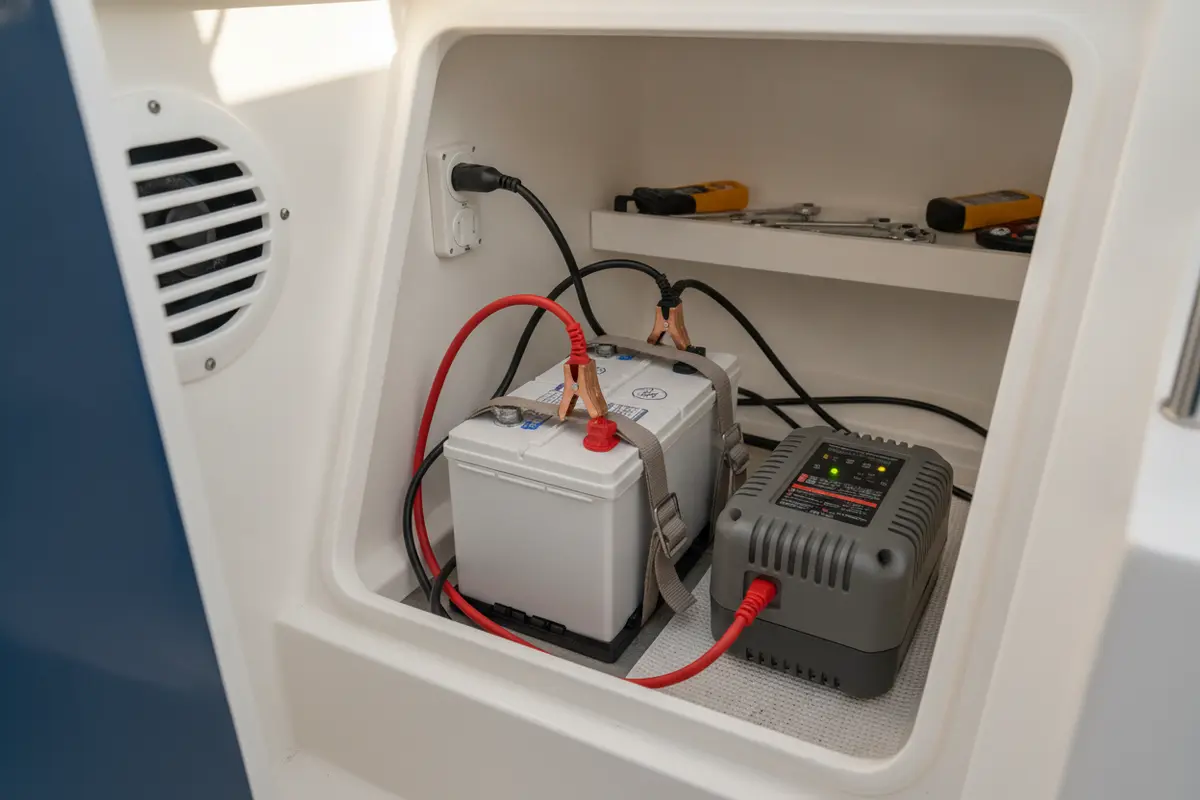
Storage instructions vary by battery chemistry, model, climate, and whether the battery stays aboard. Check the manual before disconnecting or removing it. If removal is allowed and appropriate, use the manufacturer’s procedure, keep the battery upright where required, and store it in the specified temperature and ventilation conditions. Protect terminals from accidental contact with metal objects.
Do not leave a battery discharged for an extended period unless its manufacturer specifically directs otherwise. Before storage, charge it as instructed and use only a compatible maintenance charger or monitoring method. Check it at the interval the manufacturer recommends. Avoid assuming that a trickle charger can remain connected indefinitely; the device and battery must be approved for that use.
Before leaving the boat, confirm that the battery compartment is dry and that terminals are protected as directed. Make sure the battery is restrained and that no loose tools, spare hardware, or other metal objects can contact the terminals. If the battery is removed for storage, label it so its location and intended use are clear, and keep it away from children and anything that could damage its case. Do not store a battery beside fuels or in a location that conflicts with its manual.
For a battery that stays aboard, understand which devices could continue drawing power when the boat is unattended. Some electronics or monitoring devices may need power; others may be switched off. Do not disconnect equipment blindly. Ask a marine technician to help identify an unexplained draw if the battery repeatedly loses charge while idle. A record of the starting condition and later symptoms can help determine whether the issue is normal self-discharge, an accessory, or a fault.
Cold weather makes preparation especially important for boaters in Massachusetts, but battery storage is not the same as a full boat winterization plan. Keep this task focused: follow battery-specific instructions, protect the battery from damage, and arrange professional help if the system cannot be safely isolated. Our fleet information can help with a broader readiness review before a trip.
| Maintenance task | What to check | When to act |
|---|---|---|
| Visual inspection | Case condition, residue, cable condition, battery restraint, and a clean, dry compartment | Before outings; investigate damage or leaks before use |
| Connection check | Terminals and cable ends are secure, clean, and free of visible corrosion | On a routine schedule; isolate power before any approved service |
| Charging | Charger compatibility, settings, cables, and manufacturer instructions | When needed and before storage, using the correct procedure |
| Storage | Charge level, location, temperature, ventilation, and monitoring requirements | Before a period of nonuse and at the maker’s stated check interval |
| Professional assessment | Repeated discharge, slow starts, warning messages, or suspected system faults | Promptly, rather than repeatedly charging or changing settings |
What warning signs mean you should stop and get help?
Stop using or charging a battery if its case is cracked, swollen, leaking, unusually hot, or emitting an unusual odor. Also stop if you see damaged cables, sparking, smoke, or a charger warning that you cannot resolve using the manuals. Keep clear of the battery and contact a qualified marine technician. If there is immediate danger, follow the boat’s emergency procedures and contact emergency services.
Repeated weak starts, unexplained power loss, and a battery that discharges while the boat is idle deserve attention too. Avoid treating repeated jump-starts or frequent recharging as a repair. Ask for an assessment of both the battery and the charging system. Record symptoms, recent charging, and which equipment was in use; clear notes can make diagnosis more efficient.
If you are gaining confidence on the water, practical instruction can help you understand the boat’s equipment and routines. Learn more about on-the-water training and review the club’s frequently asked questions for general membership information.
Talk with our team about a tour
What are common questions about boat battery maintenance?
How often should you check a boat battery?
Look it over before outings and follow the manufacturer’s schedule for more detailed checks. Inspect it again before a period of storage and at any interval the maker specifies. A change in starting performance, visible corrosion, or a warning from the charging system is a reason to check sooner.
Can you use a car battery charger on a boat battery?
Only if the charger is explicitly compatible with that exact battery chemistry and electrical system, and its instructions allow the intended use. Do not assume that a charger suitable for one vehicle battery is suitable for every marine battery. When uncertain, ask the battery maker or a marine technician.
Should you disconnect a boat battery when the boat is not in use?
That depends on the boat’s wiring, equipment, and battery instructions. Some systems may rely on continuous power for particular functions. Follow the boat and battery manuals, and ask a qualified technician if you cannot confirm what will be affected by disconnecting it.
What should you do if a battery terminal has corrosion?
Do not scrape or clean an energized connection. Isolate power only by the boat’s approved procedure, use suitable protective equipment, and follow the manufacturer’s cleaning instructions. If there is damage, leakage, or uncertainty about safe isolation, stop and get qualified help.
How can you make the routine easy to repeat?
Keep the battery manual with the boat’s records, note the battery type and charger compatibility, and add a brief inspection to your regular pre-departure process. Clean and secure connections only as the manufacturer allows. Take unusual symptoms seriously instead of waiting for the next outing to see whether they disappear. Consistent, careful checks help you make informed decisions and enjoy more prepared days on Massachusetts waters. If you are exploring ways to get out on the water without owning a boat, read about boat club membership in Massachusetts.