
Getting out on Massachusetts water starts with more than choosing a boat and checking the weather. The state’s boater education rules are changing, and the terminology can be confusing: Massachusetts generally refers to a Boater Safety Certificate rather than a traditional operator license.
Schedule Your Tour and learn how boating without owning works in Massachusetts.
A Massachusetts boating license usually means completing a NASBLA-approved boater safety course and earning the required certificate. Anyone born on or after January 1, 1989, must complete the course. While those born on or before January 1, 1989, must obtain their certificate before April 1, 2028.
Whether you choose an approved online course or an in-person class, the certificate gives you the foundation for legal, responsible operation. The next step is understanding exactly who must be certified, when each deadline applies, and how age affects what you may operate.
Do You Need a Boating License in Massachusetts?
Massachusetts does not issue a traditional, driver’s-style boating license. Instead, most people who operate a motorboat or personal watercraft (PWC) on Massachusetts waterways must obtain a Boater Safety Certificate through a NASBLA-approved course. The requirement applies based on the operator’s birth date, not whether they own the boat.
If you were born on or after January 1, 1989, you must complete an approved boater safety course and obtain your certificate by April 1, 2026. This requirement comes from the Hanson-Milone Boater Safety Act, which makes boater education a condition of operating a motorboat in the state. Although the deadline arrives April 1, penalties will not be assessed until September 1, 2026, so completing the course early is the safer choice.
If you were born on or before January 1, 1989, you also need to obtain a Boater Safety Certificate, but your deadline is April 1, 2028. The phased schedule gives older operators additional time to meet the requirement, but it does not permanently exempt them from certification.
What does this requirement cover?
The rule affects operators of motorboats and PWCs, including people using a friend’s boat, a rented vessel, or a club boat. It is separate from vessel registration and from any practical instruction you may receive after earning your certificate. The certificate demonstrates completion of required safety education. It does not replace the need to understand local waterways, handle a boat confidently, or follow Massachusetts navigation and safety laws.
Course options and current state guidance can change, so review the official Massachusetts boater safety certificate guidance before enrolling. The state page explains the approved-course process and the deadlines tied to your birth date.
In short, the answer to “Do you need a Massachusetts boating license?” is technically no, but most operators do need a Boater Safety Certificate. Check your birth date, complete an approved course before your applicable deadline, and keep your certificate available when operating on Massachusetts waters.
What Is the Hanson-Milone Boater Safety Act?
The Hanson-Milone Boater Safety Act is the Massachusetts law that expands mandatory boater education across the state. Signed by Gov. Maura Healey on January 8, 2025, the law takes effect April 1, 2026. It requires eligible operators to complete a qualifying boater safety course and carry the resulting certificate when operating a motorboat.
The law was created with a practical goal: improve boating safety before accidents happen. A consistent education requirement helps more operators understand navigation rules, required safety equipment, Massachusetts boating laws, and responsible operation on crowded waterways. Better preparation can reduce preventable collisions, injuries, and other boating accidents.
For current certification details, review the official Massachusetts boater safety certificate guidance. Massachusetts generally refers to this credential as a boater safety certificate rather than a traditional Massachusetts boating license.
How does the law phase in?
The rollout uses two birth-date groups.
- Born on or after January 1, 1989: You must complete a NASBLA-approved boater safety course and obtain your certificate by April 1, 2026, to operate a motorboat under the new requirement.
- Born on or before January 1, 1989: You must obtain your certificate by April 1, 2028.
The earlier deadline does not mean operators in the first group face immediate penalties on the effective date. No operator will be assessed a penalty until September 1, 2026. That enforcement grace period provides time to find an approved course, complete the instruction, and obtain documentation, but waiting until the last minute can make scheduling more difficult.
What should Massachusetts boaters do now?
Check your birth date against the phase-in schedule, then choose a course approved by the Massachusetts Environmental Police. Keep your certificate accessible when you operate. Completing the requirement early also gives you time to review the material and build confidence before the boating season becomes busy.
Can You Get a Massachusetts Boating License Online?
Yes. Massachusetts offers approved boater safety courses online as well as in person. Both formats are approved by the Massachusetts Environmental Police, so the better choice depends on your schedule, learning preferences, and how soon you want to complete the requirement. The state generally refers to this credential as a boater safety certificate rather than a traditional Massachusetts boating license.
| Option | Format and time | Typical cost | Approval and considerations |
|---|---|---|---|
| Boat Massachusetts | Online and self-paced | About $45 | Approved course option available through Massachusetts boating resources. |
| Boat-Ed | Online and self-paced | About $30 to $60 | Choose the Massachusetts-specific course and confirm its current approval before enrolling. |
| iLearnToBoat | Online and self-paced | $74.95 | The Massachusetts course is approved and meets the state requirement. |
| Classroom course | In person, usually 10 to 12 hours over several days | Varies by provider | Approved format that offers scheduled instruction and the opportunity to ask questions in real time. |
Why choose an online course?
An online course is convenient if you need to fit study time around work, family, or travel. You can work through the material at your own pace instead of attending a scheduled classroom session. Before paying, verify that the course is specifically approved for Massachusetts and that it issues the certificate accepted by the state.
What about the free Boat US Foundation course?
The Boat US Foundation course is free, but it is not NASBLA-approved in Massachusetts. Treat it as a supplemental educational resource, not as the state-approved course needed for Massachusetts certification. If you choose an online provider, the Massachusetts-approved iLearnToBoat option is distinct from that free supplemental course.
For the latest provider and certification information, contact the Massachusetts Boat and Recreation Vehicle Safety Bureau at (978) 646-7230 or review the official Massachusetts boater safety course guidance.
What Does the Massachusetts Boater Safety Course Cover?
A NASBLA-approved course combines practical safety knowledge with the rules operators need on Massachusetts waterways. You must be at least 12 years old to take the online version. The course uses live-action HD videos and comprehensive instruction to make important concepts easier to understand, whether you are preparing for your first season or formalizing experience you already have.
Navigation Rules and Massachusetts Boating Laws
Lessons explain navigation rules, commonly called the rules of the road, so operators can interpret traffic situations, maintain a proper lookout, and reduce collision risks. The curriculum also covers Massachusetts boating laws, including responsible operation, required registration and safety responsibilities. These rules are not just test material. They help you make sound decisions when visibility changes, waterways become busy, or conditions shift.
Safety Equipment and Emergency Readiness
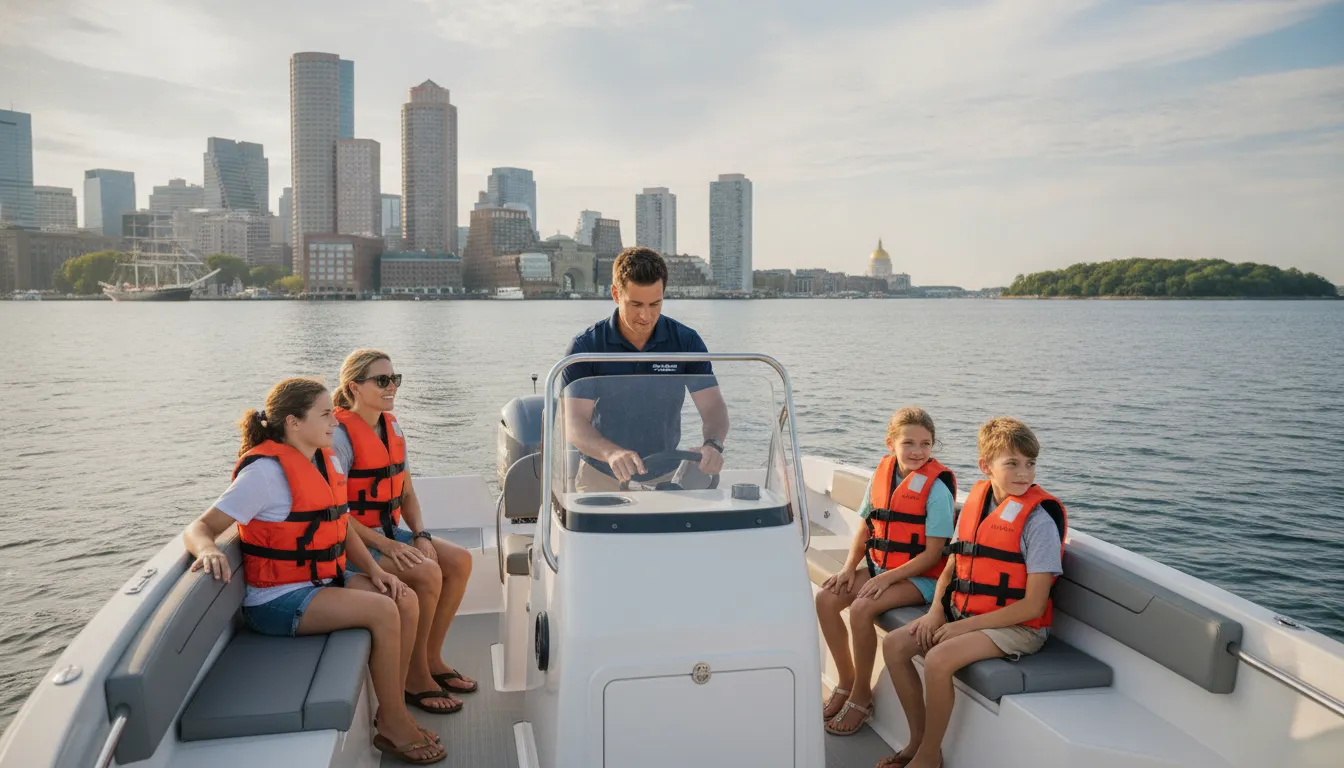
The course reviews the equipment that supports passengers in an emergency. Topics include USCG-approved life jackets, marine fire extinguishers, and visual signaling devices. Massachusetts requires one approved personal flotation device for each person aboard, while additional equipment requirements depend on the vessel and how it is being used. Students also learn why sound-producing devices, navigation lights, and an engine cut-off switch, when equipped, matter during routine operation and emergencies. See the Carefree Boat Club FAQ for practical questions about safety procedures and boating with the club.
Personal Watercraft and Environmental Awareness
Personal watercraft, including jet skis, have specific operating rules and handling considerations. The course addresses those rules alongside safe speeds, awareness of other boaters and swimmers, and responsible behavior around shorelines and wildlife. Environmental and ecological awareness helps operators protect the waterways they enjoy by limiting disturbance, preventing pollution, and treating natural areas with care.
After completing the approved course, operators receive their official Massachusetts Boater Safety Certificate. The certificate confirms completion of the required education, while hands-on training can help turn that knowledge into confident boat handling.
What Are the Massachusetts Boating License Age Requirements?
Massachusetts sets different rules for motorboats and personal watercraft based on the operator’s age. Understanding the cutoff that applies to you, or to a young person in your family, helps you plan training before getting underway.
-
Under age 12: Do not operate a motorboat
Massachusetts law prohibits anyone under 12 from operating a motorboat. This rule applies even when a child has boating experience or is accompanied by an adult. A child may enjoy time aboard with a responsible operator, but the adult must remain the person operating the motorboat. Children under 12 should also receive age-appropriate safety instruction, including how to wear and use a properly fitted life jacket.
-
Ages 12 through 15: Complete the required course before operating alone
After March 31, 2026, operators ages 12 through 15 must complete an approved basic boating course before operating a motorboat without adult supervision. The course provides foundational instruction in navigation rules, safety equipment, and Massachusetts boating laws. Anyone taking the online boater safety course must be at least 12 years old.
Completing a course does not remove the need for good judgment. Younger operators should understand the boat’s controls, check weather and water conditions, and know when to ask an experienced adult for help. Families can also reinforce classroom learning through practical instruction and supervised time on the water.
-
Under age 16: Do not operate a personal watercraft
No person under 16 may operate a personal watercraft, or PWC, in Massachusetts. A PWC includes vessels such as jet skis that use a motor and water-jet propulsion. A young boater who can legally operate a motorboat may still be prohibited from operating a PWC because the age limits are separate.
-
Age 16 and older: Check your certification and boat type
Turning 16 does not eliminate every boating requirement. Before operating, confirm whether your birth year requires a Massachusetts boater safety certificate and whether the specific boat or activity has additional rules. Approved course information is available through the on-the-water training program, while current state requirements should be verified with the Massachusetts Environmental Police.
For the official age restrictions and certification guidance, review the Massachusetts boater safety certificate requirements.
How Does Carefree Boat Club Complement Your Massachusetts Boating Certification?
Completing the required Massachusetts boating education course gives you the knowledge needed to understand boating laws, navigation rules, and basic safety practices. It does not automatically give you experience handling a boat in changing real-world conditions. Carefree Boat Club’s on-the-water training is designed to bridge that gap. It complements the state certification process, but it does not replace the required Boater Safety Certificate.
How does Carefree training differ from the state course?
The state course focuses on the classroom and knowledge portion of boating safety. Carefree adds practical experience with certified instructors on local waterways. All members must demonstrate proficiency, regardless of previous boating experience, before operating independently. That approach helps new boaters build confidence while giving experienced boaters a chance to become familiar with local conditions and club procedures.
Through the club’s on-the-water training program, members can work on skills such as boat handling, docking, departure and arrival procedures, and safe navigation. Instructors can also help members understand the waterways they are most likely to use, including routes, destinations, and conditions around Boston Harbor and the North Shore.
What can members learn on Massachusetts waterways?
Practical instruction is about more than controlling the boat. Carefree trainers help members learn local waterways, places to go, things to do, and fishing spots. That local knowledge can make a boating day more enjoyable and help members plan trips that match their comfort level and experience. Training is available to members as they continue developing their skills, rather than being limited to a single orientation session.
Carefree Boat Club serves members from its Massachusetts locations in Boston, Danvers, and Gloucester. The club is family-owned and operated, not a franchise, and its membership model is built around “Boating Without Owning.” To learn what is included, review the Carefree Boat Club membership options. The right combination of state certification and supervised practice can help you enjoy the water with greater confidence, preparation, and respect for local boating conditions.
What Are the Frequently Asked Questions?
Is a Massachusetts boating license the same as a boater safety certificate?
Not exactly. Massachusetts generally refers to the required credential as a Boater Safety Certificate rather than a traditional boating license. Operators who meet the applicable age requirements must complete a NASBLA-approved course and carry the resulting certificate. The certificate is valid for the operator’s lifetime, so annual renewal is not required. Mass.gov explains the certification requirement.
Can I complete the required boating course online?
Yes. Massachusetts recognizes approved online and classroom course options, provided the course meets Massachusetts Environmental Police requirements. Online learning can be convenient for adults who prefer to study at their own pace, while classroom instruction offers scheduled, in-person guidance. Check the state’s approved-course information before enrolling, because a general boating education resource may not satisfy the certification requirement.
Who needs a Massachusetts Boater Safety Certificate?
Anyone born on or after January 1, 1989, must complete a NASBLA-approved boater safety course to operate a motorboat in Massachusetts. People born on or before January 1, 1989, also have a certification deadline: the certificate must be obtained before April 1, 2028. The state identifies these requirements under the Hanson-Milone Boater Safety Act. Review the official deadlines at Mass.gov.
How do I get my Massachusetts boating license?
Choose an approved online or in-person boater safety course, complete the required instruction and assessment, and receive your Boater Safety Certificate. If you are uncertain whether a provider or course qualifies, contact the Massachusetts Boat and Recreation Vehicle Safety Bureau at (978) 646-7230 before registering.
What age rules should families know before boating?
Children under 12 may not operate a motorboat in Massachusetts. A person under 16 may not operate a personal watercraft, such as a jet ski. Young boaters should also follow the state’s supervision, safety-equipment, and certificate requirements before taking the helm. Mass.gov lists the current age restrictions.
Ready to Book Your Massachusetts Boating Next Step?
Schedule Your Tour to learn more about Carefree Boat Club membership.
Completing your certificate is an important foundation, and local on-the-water training can help you feel more comfortable applying what you learned. Carefree Boat Club offers professional instruction for members across Boston Harbor, Danvers, and Gloucester waterways.