
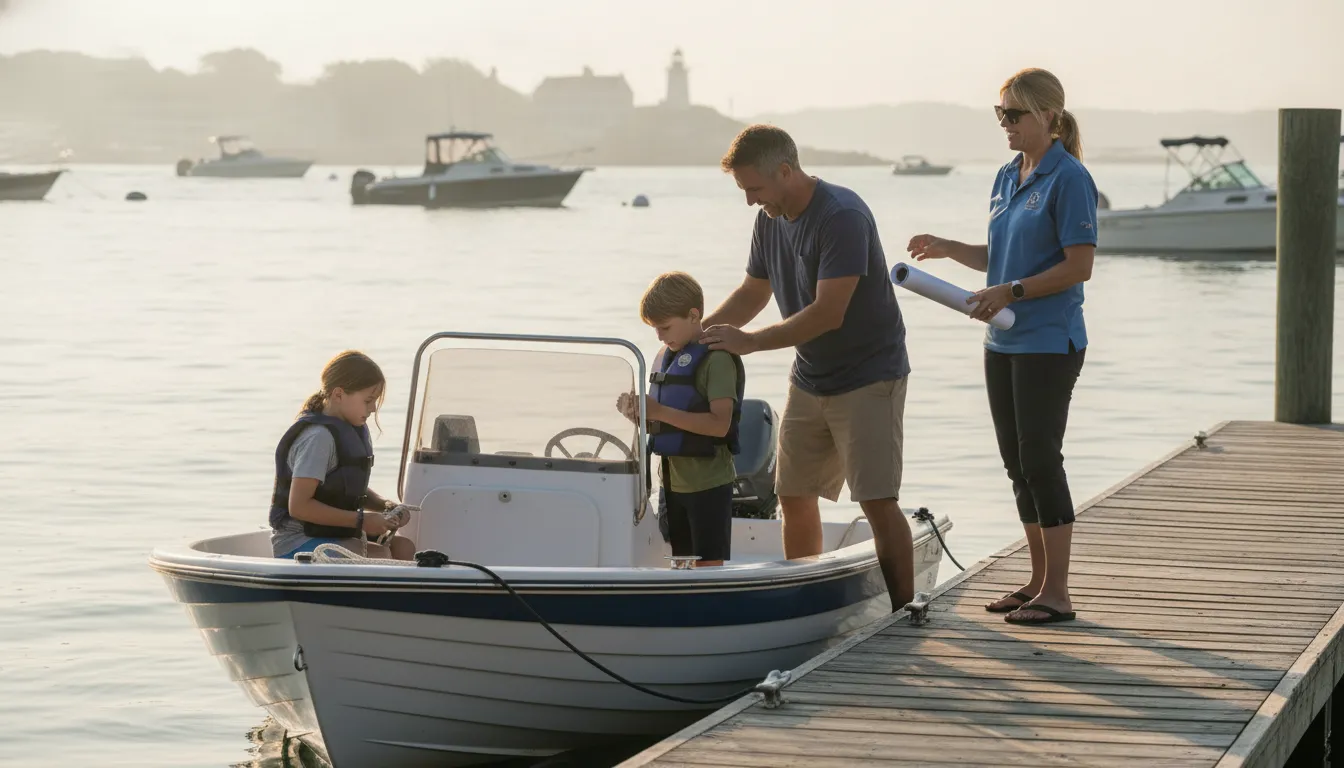
Getting ready to operate a motorboat or personal watercraft in Massachusetts involves more than an online quiz. This guide explains how to get a Massachusetts boating license online, which the state generally describes as earning a boater safety certificate. Choose an approved course, complete the education, keep your certificate, and learn when you must carry proof on the water.
Book a Carefree Boat Club tour to keep building your boating confidence.
For how to get massachusetts boating license online, start with the official Massachusetts course page and select an approved online provider. After you successfully complete the course, save your boating safety certificate and review the current rules for your vessel and age group. Massachusetts says a valid certificate is required for motorboat and PWC operators beginning April 1, 2026: Mass.gov course guidance and boating law summary.
Before enrolling, it helps to understand what the certificate does, which course options count, and what documentation you should have ready after completion.
How Do You Get a Massachusetts Boating License Online?
| Step | Action | Purpose |
|---|---|---|
| 1 | Open the official Massachusetts course page. | Find approved online providers. |
| 2 | Complete the course and assessments. | Meet the provider’s requirements. |
| 3 | Save your certificate and proof. | Keep required documentation available. |
| 4 | Review rules and practice safely. | Apply education responsibly. |
Many people search for how to get a Massachusetts boating license online. Massachusetts generally uses a different term: a boater safety certificate. The everyday phrase “boating license” can make it sound like you apply for a standard driver’s-license-style credential. In practice, the state focuses on approved boating safety education and proof of completion when the rules require it.
Massachusetts offers an online education option for completing a boating safety course. The state’s official boat safety certificate course page explains the available option and lists approved online course providers. Start there rather than choosing a course from a general search result, because approval is important to whether the course can support a Massachusetts boating safety certificate.
What is the difference between a license and a safety certificate?
A boating safety certificate shows that you successfully completed an approved education course. It is not a blanket promise that you can operate every type of vessel in every situation. It also does not replace the need to understand current Massachusetts boating laws. The terminology matters because it helps you look for the right state information and avoid assuming that any online boating class will meet Massachusetts requirements.
After successful completion of the Massachusetts Environmental Police boating safety course, students receive a safety certificate. The official course page also identifies the online pathway and its approved providers. Follow the current instructions supplied by Massachusetts and the approved provider you select. Provider websites may explain their own enrollment, learning, testing, and certificate-delivery steps, but those details should not be treated as universal state rules unless Massachusetts confirms them.
What is the high-level online process?
At a high level, the process is straightforward:
- Visit the Massachusetts boating safety course page.
- Review the online education option and choose a provider listed by the state.
- Register with that provider and complete the assigned safety lessons and assessments.
- Finish the course successfully and follow the provider’s instructions for receiving your safety certificate.
- Keep proof of completion available for future boating activities and check the state’s latest requirements before heading out.
Timing also matters. Beginning April 1, 2026, Massachusetts requires a valid boater safety certificate for all individuals operating motorboats and personal watercraft, according to the state’s boating law summary. The exact rules can depend on the type of operation and other circumstances, so review the current state guidance rather than relying on a simplified “license” label.
This section is the online-course foundation for the Massachusetts boating license requirements guide. The next sections explain how to evaluate approved courses and what to do after completion. If you are also comparing practical boating questions with membership questions, the boating and membership FAQs provide additional context without changing the state’s certificate requirements.
Which Online Courses Are Approved by Massachusetts?
When you search for how to get massachusetts boating license online, start with the state rather than an advertisement. Massachusetts maintains an official boat safety certificate course page that identifies the online education option and displays a list of approved course providers. Use that page as your verification point before creating an account or beginning a course.
Look for the provider’s name on the current Mass.gov list, then confirm that the course is specifically presented as a Massachusetts boater safety course. A provider may describe its program as approved, accepted, or nationally recognized in marketing materials. Those statements are not a substitute for checking the state’s official provider list. The practical question is whether the course is one Massachusetts recognizes for earning a boater safety certificate.
What does approval actually mean?
Approval involves more than a course having boating content or a familiar brand name. The Mass.gov course page states that the Massachusetts Boat Ed course is approved by the National Association of State Boating Law Administrators. This organization is also called NASBLA. The course meets U.S. Boating Education Standards. NASBLA recognition speaks to education standards. The Massachusetts Environmental Police and the state’s approved-provider list establish the Massachusetts connection. Treat both pieces as useful, but do not confuse them.
Massachusetts says a boater may obtain a certificate after successfully completing an approved course offered by the Massachusetts Environmental Police or an approved partner program. Read the wording carefully: completing a course is not the same as simply registering, watching a few videos, or receiving a promotional completion badge. Follow the provider’s completion requirements, and retain the certificate or other proof it supplies after you pass.
Do age and existing credentials change the process?
Age rules apply to operation, not just enrollment. A person under 12 may not operate a motorboat unless directly supervised onboard by a competent adult who is at least 18. Personal watercraft operators must still be at least 16, with no exceptions. Completing an online course does not override either operating-age rule. Review the current Massachusetts boating law summary before taking a child or teenager on a particular vessel.
You may not need a full online course in every situation. Massachusetts notes that some people with a U.S. Coast Guard credential or an out-of-state credential may be eligible for a certificate without completing the full course. Eligibility depends on the credential and the state’s current process. Contact the appropriate Massachusetts authority or follow the instructions on Mass.gov. Do not assume an out-of-state document qualifies. This careful check can prevent a last-minute documentation problem before you launch.
What Steps Should You Follow to Complete the Online Course?
If you are researching how to get massachusetts boating license online, think of the process as a short series of decisions and study tasks. Massachusetts offers an online education option, but you should begin with the state’s official provider list rather than choosing a course from a general search result. That check helps you confirm that the course is intended for Massachusetts certification and fits your age, vessel, and operating plans.
- Start with the official Massachusetts course page. Review the approved online providers listed by Massachusetts and select a course that clearly identifies its Massachusetts approval or acceptance. The state explains that students can sign up for an online safety course and receive a safety certificate after successfully completing an approved course. Read the current state instructions before enrolling, because approval and eligibility details can change. Review the Massachusetts boating safety course information first.
- Confirm that the course covers your situation. Check the provider’s eligibility language, course scope, and certification process. Do not assume that every online course has the same age rules, exam format, or documentation timeline. If you have a United States Coast Guard credential or an out-of-state credential, Massachusetts says you may qualify in some cases without taking a full course. Verify that possibility with the state before paying for or beginning a class.
- Create your account and work through every module. Use an email address you can access later, and keep your login information in a secure place. Study the navigation, rules of the road, weather, emergencies, equipment, and responsible-boating material instead of clicking through only to reach the test. Take notes on unfamiliar terms and pause when you need to review a topic. A self-paced format can be convenient, but completing the material carefully is what makes the course useful on the water.
- Complete the quizzes and final exam according to your provider’s rules. For example, Boat Ed states that its Massachusetts course requires at least 80 percent on unit quizzes and at least 80 percent on the final exam. Boat Ed also states that students must restudy a failed unit before retaking that quiz, and that the online exam allows unlimited attempts. These are Boat Ed’s stated procedures, not universal rules for every Massachusetts-approved provider. Confirm the requirements displayed in the course you actually choose at Boat Ed’s Massachusetts course page.
- Save your completion records and certificate proof. Download or print every document the provider makes available after you pass. Boat Ed states that a temporary certificate can be printed immediately after passing and paying for its course, or requested as a PDF by email. It also states that its temporary certificate expires 365 days after course completion and that its permanent safety certificate arrives within three to five weeks after all certification requirements are completed. Keep those timelines attributed to Boat Ed, and follow your provider’s instructions if you choose a different course.
- Check the current Massachusetts requirements before operating. Finishing an online course is not the same as having unrestricted permission to operate every type of vessel. Review the current state law summary, confirm what proof must be available onboard, and resolve any age or vessel-specific questions before your first trip. Store a readable copy of your documentation where you can retrieve it quickly, then continue building practical skills beyond the online lessons.
What Happens After You Complete the Online Course?
Finishing the lessons and passing the assessment is an important step, but it is not the end of the process. Massachusetts treats the result as a boater safety certificate. Keep the completion documentation available, understand which boats and operators the rule covers, and check the current state guidance before heading out.
What proof should you keep with you?
Massachusetts law requires operators of motorboats and personal watercraft to carry proof that they completed an approved boater education course while on the water. The Hanson-Milone Act FAQ similarly explains that a person operating a motorboat generally must have the certificate on board and available for inspection. Unless the person is directly supervised by someone with a certificate or falls under an applicable exemption. Read the current Massachusetts boating law summary and the Hanson-Milone Boater Safety Act FAQ for the latest requirements.
Save the certificate or other approved proof in a place you can access on the boat. Follow the issuing provider’s instructions for obtaining your documentation, and do not assume that a course-completion screen, email, or temporary document has the same status in every situation. The state pages are the right place to confirm what proof is accepted.
When do Massachusetts certificate deadlines apply?
The law summary lists different deadlines based on birth date. Under the current summary, people born after January 1, 1989 must obtain a certificate by April 1, 2026. It also states that penalties for this group will not be enforced until September 1, 2026. People born on or before January 1, 1989 must obtain a certificate before April 1, 2028. These dates are tied to the current implementation of the law, so verify them on Mass.gov before relying on them for a future trip.
Is a boater safety certificate a universal license?
No. A Massachusetts certificate confirms completion of an approved safety education course. It should not be described as a universal license that authorizes every person to operate every type of vessel under every circumstance. The requirements generally apply to motorboats, including vessels propelled by machinery even when machinery is not the vessel’s only source of propulsion. Personal watercraft rules and age restrictions may also apply separately.
The FAQ notes that U.S. Coast Guard-documented vessels are not considered motorboats for this certificate requirement, and their operators are not subject to it under that rule. Other exceptions or credential pathways may exist. Because vessel status, supervision, age, and credentials can change the analysis, check the official Mass.gov rules and FAQs for your specific situation. Completing an online course can show that you met an education requirement, but practical preparation and responsible operation still matter once you are on Massachusetts waters.
How Can You Prepare for Safe Boating After Certification?
Completing an approved Massachusetts boating safety course gives you an important foundation, but an online certificate is not a substitute for time at the helm. The next step is to turn what you studied into repeatable habits: checking equipment. Reading conditions, communicating clearly, and handling the boat at low speed before you venture farther from shore.
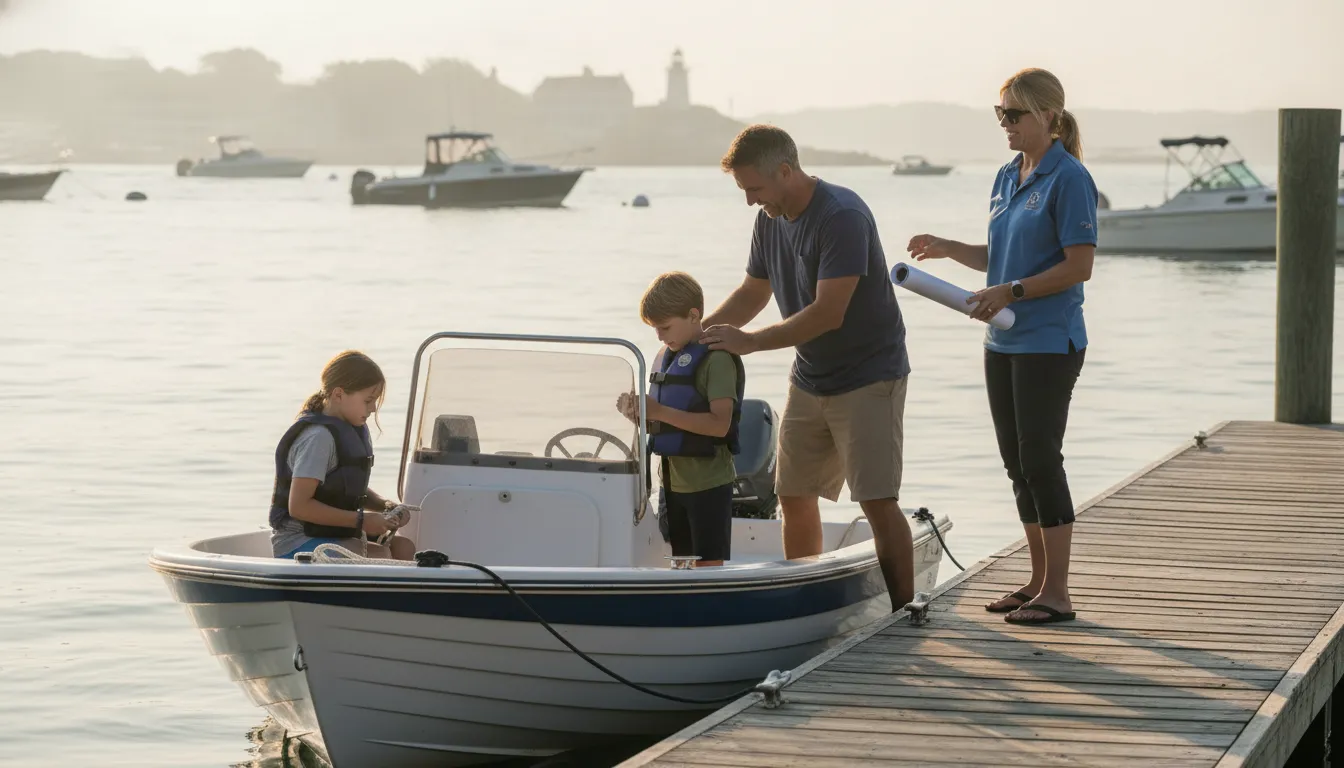
Start with the basics on every outing. Massachusetts recommends wearing a life jacket every time you are on the water, not only when conditions look rough. Choose a properly fitted life jacket for each person, make sure it is in good condition, and keep it readily accessible. Cold-water immersion causes many boating-related fatalities, so New England boaters should take water temperature seriously even on a calm, sunny day. Dress for the water, tell someone where you are going, and know how you would get help if a passenger fell overboard.
Then practice the skills that an online course cannot fully reproduce. Learn how your boat responds in forward and reverse, how much room it needs to turn, and how wind and current affect docking. Practice departing and returning to the dock at a quiet time. Review the location of safety equipment, operate the VHF radio appropriately, and use the chartplotter or GPS while still keeping an active visual watch. A short, supervised practice session can reveal questions that are easy to miss in a digital lesson.
For Carefree Boat Club members, club training supplements state certification with practical instruction. Carefree provides certified-instructor, on-water training along with additional off-water guidance. The program covers club processes, general navigation, docking, and safety, and instruction can be tailored to novice boaters or seasoned skippers. Its documented curriculum also addresses safety equipment, boat systems, VHF procedures, GPS navigation, local hazards and channels, motor operation, emergency procedures, and docking. You can learn more about on-the-water training before deciding which skills you want to build next.
That local practice is especially useful when you are learning the waters around Boston, Danvers, or Gloucester. As your experience grows. Reciprocal access to more than 150 Carefree locations can also give members opportunities to learn in new boating areas while still using the safety habits and preparation routines developed at home. Always confirm current Massachusetts requirements separately and carry any required proof of course completion. Certification starts the process; calm, consistent practice builds confidence.
What Should Massachusetts Boaters Check Before Their First Trip?
Finishing an online course is an important step, but a certificate does not replace a calm, practical pre-departure routine. Before leaving a Massachusetts marina, give yourself a few minutes to confirm the essentials and think through the conditions you are likely to encounter.
- Keep your proof onboard. Carry your approved boating education certificate or other required proof where it can be produced if needed. Keep a backup copy stored securely on your phone, but do not rely on a device that may lose power or signal.
- Check life jackets and safety equipment. Confirm that properly fitting life jackets are available for everyone before the boat moves. Massachusetts recommends wearing a life jacket every time you are on the water, and personal watercraft users must wear them. A quick inspection is especially important when guests or children are joining you.
- Review the weather and water conditions. Look beyond the temperature. Check wind, visibility, thunderstorms, tide information where relevant, and the expected conditions along your route. Cold-water immersion is a cause of many boating-related fatalities in Massachusetts. So treat an unexpectedly chilly or worsening forecast as a reason to shorten, delay, or change the trip. Review Massachusetts boating safety guidance before departure.
- Know the route and local hazards. Identify your launch point, destination, safe return route, channels, no-wake areas, shoals, rocks, and bridges or other restrictions shown on current navigation resources. If you are new to Boston Harbor or the North Shore, study the Boston Harbor boating guide as supplemental local orientation. The boat navigation basics guide can also help refresh chart-reading and navigation habits.
- Test communication tools. Turn on the VHF radio, confirm that you understand basic radio procedures, and check that your phone is charged and protected from water. Make sure everyone knows how to call for help and where emergency equipment is located.
- Practice the first docking plan. Talk through who will handle lines, who will watch surroundings, and how you will approach the dock in the expected wind and current. A simple plan reduces rushed decisions when the boat is moving slowly in a busy marina.
- Share an emergency plan. Tell someone on shore where you are going, when you expect to return, and who is onboard. Review what to do if the engine stops, someone falls overboard, weather changes, or the group needs to return early.
Club instruction can make this checklist easier to apply on the water. Carefree Boat Club training is supplemental practical preparation, not a substitute for Massachusetts certification. Its documented curriculum includes safety equipment, boat systems, VHF procedures, GPS navigation. Local hazards and channels, emergencies, and docking, with instruction designed for both novice boaters and seasoned skippers.
Frequently Asked Questions
Can you get a Massachusetts boating license fully online?
Massachusetts offers an online boating safety education option through approved providers. Start with the official Mass.gov course page, choose an approved course, complete its lessons and assessments, and follow the provider’s instructions for receiving your safety certificate. The state generally refers to this document as a boating safety certificate rather than a universal license.
How long does it take to complete the online boating course?
The timeline depends on the approved provider, your study pace, and how quickly you complete the required assessments. Some courses let students work through the material over multiple sessions, while others may be completed in one sitting. Plan enough time to understand navigation, equipment, emergency procedures, and local boating rules instead of rushing to finish.
What proof do you receive after completing the course?
After successful completion, students receive a boating safety certificate. Massachusetts requires operators to carry proof of an approved boater education course while operating motorboats and personal watercraft on Massachusetts waters. Subject to the exceptions and timing described in the current Massachusetts boating law summary. Save a digital and printed copy, and check the current state instructions before your first trip.
Does the certificate allow you to operate any boat in Massachusetts?
No. The certificate requirement applies to motorboats, including vessels propelled by machinery, but it does not replace every age, supervision, vessel, or operating rule. For example, PWC operators must be at least 16, and some U.S. Coast Guard-documented vessels are excluded from the state definition of a motorboat. Review the current Massachusetts rules for your specific situation.
What should you do after earning the certificate?
Use the certificate as a foundation, then build practical skills through supervised experience. Review weather and local hazards, practice docking and navigation, confirm your safety equipment, and wear a life jacket every time you are on the water. Supplemental on-water instruction can help connect online lessons to real boating conditions.
Ready to Build Confidence on the Water?
Completing an approved course is an important foundation, and practical guidance can help you feel more comfortable applying those lessons on the water. Carefree Boat Club can introduce you to the local team, explain membership, and discuss supplemental on-the-water training after certification.
Book a Carefree Boat Club tour to take the next step.