
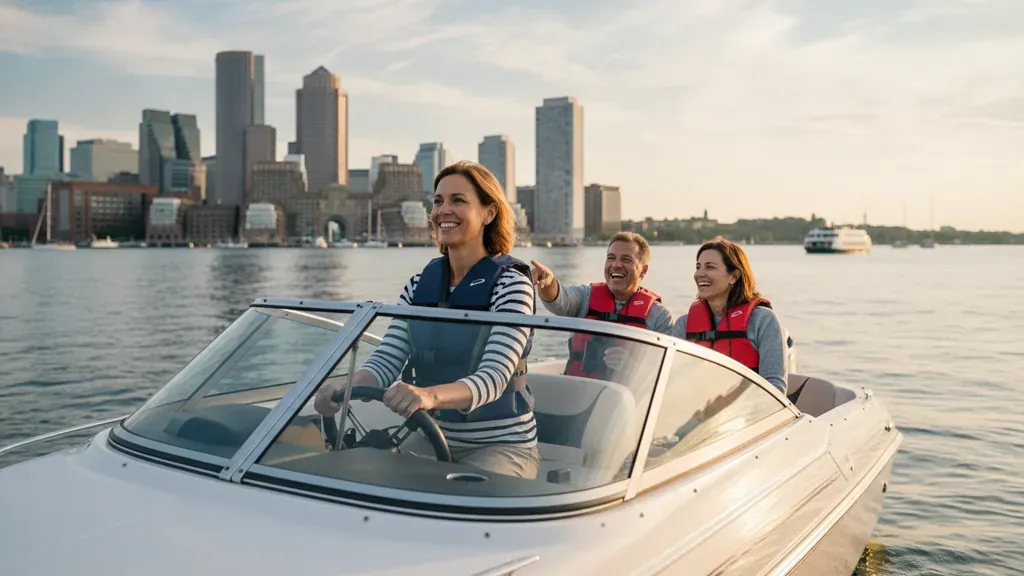
Learning how to drive a boat starts with a few fundamentals: check the boat and weather, understand the throttle and steering, move slowly around docks, and keep safety at the center of every decision. Unlike a car, a boat has no brakes and responds to wind, current, waves, and propeller movement. This beginner guide explains the basic operating sequence and the habits that make a first trip safer and more comfortable.
Book Your Carefree Boat Club Tour Today
Important: This guide is educational and does not replace a Massachusetts-approved boater education course, required certificate, boat-specific owner manual, or practical instruction from a qualified instructor. Rules and equipment vary by vessel and waterway. When in doubt, slow down, ask for help, and follow the manufacturer’s instructions.
How Do You Prepare to Drive a Boat?
The safest boat trip begins before the engine starts. Give yourself enough time to inspect the boat, review the conditions, and explain the plan to everyone aboard. A rushed departure creates avoidable problems, especially when a new operator is trying to manage lines, passengers, controls, and nearby traffic at the same time.
Check the weather and route
Review the forecast, wind, visibility, tide, and expected wave conditions. In Boston Harbor, the North Shore, and Cape Ann, conditions can change quickly around exposed points, channels, and harbor entrances. Choose a first route that matches your experience and the boat. Identify a safe place to turn around or seek shelter before you leave.
Use a chart plotter, paper chart, or another reliable navigation reference to identify marked channels, shoals, rocks, restricted areas, bridges, and no-wake zones. A short familiar route is better practice than an ambitious trip that adds pressure. Carefree’s boat navigation basics guide can help you review the fundamentals before heading out.
Inspect the boat and safety equipment
- Life jackets: Confirm that every passenger has a properly fitted, US Coast Guard-approved personal flotation device. Wear yours, and make sure children use the correct size.
- Engine and controls: Check fuel, battery, fluid levels when applicable, steering response, throttle movement, and the condition of the propeller area.
- Lines and fenders: Have dock lines and fenders ready before you begin moving. Keep loose line out of the water and away from the propeller.
- Communication: Confirm that the VHF radio, phone, navigation electronics, and other required communication equipment are available and working.
- Emergency equipment: Locate the anchor, fire extinguisher, sound signal, visual distress signals, first-aid supplies, and throwable flotation device.
- Lights and visibility: Check navigation lights if you may be out near dusk or after dark. Keep the helm and sightlines clear.
Brief your passengers
Tell passengers where to sit, how to hold on, and what to do if the boat slows suddenly. Show them where the life jackets, radio, fire extinguisher, anchor, and first-aid supplies are located. Establish simple commands such as “hold on,” “line ready,” and “stop.” One calm person should help with lines while the operator keeps attention on the boat and surroundings.
How Do You Start and Leave the Dock?
Starting a boat is more than turning a key. The operator needs to confirm that the boat is ready, the throttle is in neutral, passengers are seated, and the area around the boat is clear.
- Secure the operator: Sit or stand at the helm where you have a clear view, and attach the engine safety cut-off lanyard when the boat is equipped with one.
- Ventilate when required: If the boat has a gasoline engine compartment, run the blower according to the boat manufacturer’s instructions before starting.
- Start in neutral: Place the throttle in neutral, start the engine, and listen for unusual sounds or alarms. Confirm that cooling water is flowing when the boat’s design makes that visible.
- Check the area: Look in every direction, including behind the boat. Ask your line handler to confirm that the propeller area is clear.
- Release lines carefully: Keep the boat secured until the operator and line handler are ready. Bring lines aboard rather than allowing them to trail in the water.
- Shift at idle: Move the throttle gently into forward or reverse. Avoid a sudden throttle application near a dock, swimmer, piling, or another boat.
At low speed, small throttle inputs are usually more useful than large steering movements. Keep checking behind and beside the boat as you leave the slip. Once you are in open water, pause in neutral to confirm that everyone is comfortable and that the boat is operating normally.
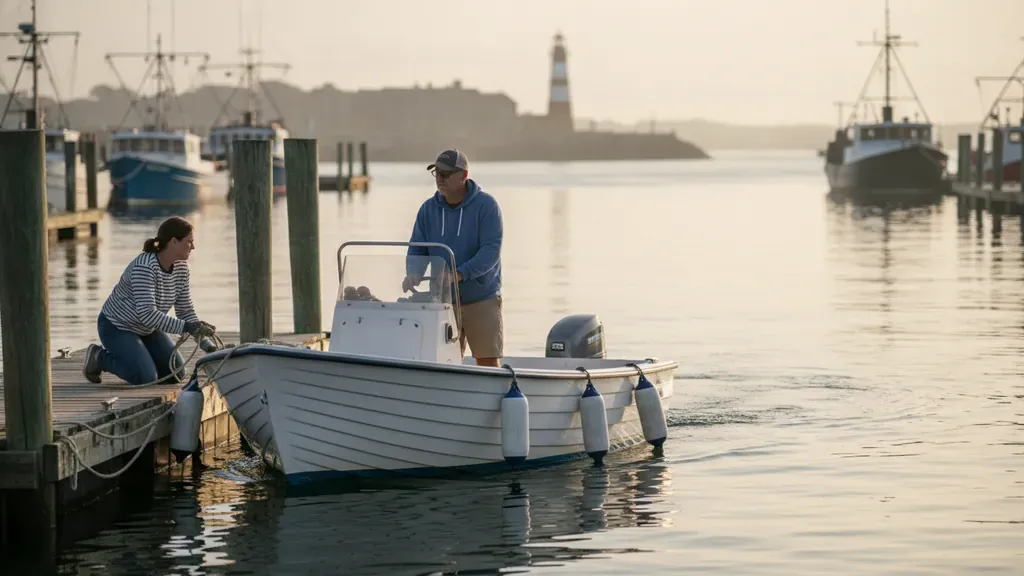
How Does Boat Steering Differ From Car Steering?
A boat’s steering wheel changes the direction of the outboard, sterndrive, or rudder. It does not turn the entire boat in the same instant that a car turns. The boat pivots through the water, and the stern can swing in the opposite direction from the bow, especially during a tight, slow-speed turn.
| Control | What it does | Beginner habit |
|---|---|---|
| Steering wheel | Directs the propulsion or rudder system | Make small inputs and watch the boat’s full path, not only the bow |
| Throttle | Selects neutral, forward, or reverse and controls power | Shift at idle and add power gradually |
| Neutral | Removes propeller thrust | Remember that the boat keeps moving after power is removed |
| Engine trim | Changes the angle of an outboard or sterndrive | Use the setting recommended for the boat and conditions |
Practice in open water
Before traveling through a crowded harbor, practice in a clear area at idle speed. Turn slightly to the right, then to the left, and observe how long the boat takes to respond. Practice returning to neutral and using a small amount of reverse to reduce forward motion. Leave plenty of room. A boat does not stop as soon as you pull the throttle back.
Steering response also depends on propulsion. Many small motorboats have little steering control when the engine is in neutral because there is no propeller wash moving across the steering surface. If you need to change direction at low speed, use short, gentle applications of forward or reverse while watching the stern and nearby hazards.
Account for wind and current
Wind and current may move the boat even when the wheel is centered. Before a maneuver, identify which way the water and wind are pushing you. Approach open space with enough room to compensate. If the boat does not respond as expected, reduce power, return to neutral when safe, and reassess rather than forcing the turn.
How Do You Control Speed and Trim?
Speed control is one of the most important parts of learning how to drive a boat. Use the lowest speed that gives you enough control for the situation. Slow down near docks, swimmers, paddlecraft, anchored boats, narrow channels, turns with limited visibility, and any posted no-wake area.
Remember three basic points:
- Boats have no brakes. Pulling the throttle to neutral removes thrust but does not erase momentum. Plan your slowdown early.
- Reverse is not a brake pedal. When appropriate and safe, use reverse power gently to reduce forward motion. A hard shift or sudden reverse application can unsettle the boat and stress the drivetrain.
- More speed does not equal more control. Extra speed reduces reaction time and increases the distance needed to stop or turn.
Engine trim changes the angle at which the boat moves through the water. The correct setting depends on the hull, load, water conditions, and manufacturer’s guidance. Keep the engine trimmed down when departing or operating in conditions that call for a lower bow attitude. In calm open water, make small adjustments and watch the boat’s ride, steering, and visibility. Never use trim as a substitute for slowing down in rough or crowded conditions.
Mid-trip reminder: Building confidence takes practice. Work through one skill at a time, and ask an experienced operator or instructor to watch your first departures, turns, and approaches.
Talk With Carefree About Hands-On Boating Training
What Should You Know About Boat Traffic and Wakes?
Operating a boat safely means sharing the water with other powerboats, sailboats, paddlecraft, swimmers, commercial traffic, and wildlife. Keep a proper lookout in every direction and use your speed, course, and sound signals in accordance with the navigation rules that apply to your waterway.
Do not assume that a familiar channel is empty because it was clear a moment ago. Check blind spots before turning, crossing a wake, or leaving a harbor. Maintain extra distance from larger vessels because they may block your view and cannot change course quickly. Learn the meaning of local buoys and markers before relying on them for a route.
Respect posted no-wake areas and reduce speed early enough that your wake has time to settle. A wake can damage docks, shift another boat, or injure passengers who are standing. In a busy place such as Boston Harbor, a calm and predictable course is safer for everyone than rapid, repeated corrections.
For a broader trip-preparation checklist, read Carefree’s boating safety tips for beginners in Massachusetts. This guide focuses on operating controls, while that resource covers weather planning, passenger preparation, float plans, and general safety habits.
How Do You Prepare to Dock a Boat?
Docking is controlled speed management, not a test of courage. Start preparing while you still have room. Confirm the wind and current, decide which side of the dock you will approach, place fenders at the correct height, and have lines ready. Ask passengers to remain seated and keep hands and feet inside the boat.
- Make a plan: Identify the approach direction, stopping point, and escape route if the approach does not look right.
- Reduce early: Slow to idle well before the dock. Use neutral when safe and allow the boat’s momentum to decrease.
- Approach at a shallow angle: A slight angle gives you room to correct and move away. Avoid approaching faster than you are willing to contact the dock.
- Use short control inputs: Small bursts of forward or reverse can help position the boat. Avoid continuous high power in a confined space.
- Keep the propeller clear: No one should enter the water or reach near the stern while the engine is running. A line handler should stay inside the boat until it is safe to step ashore.
- Secure before relaxing: Once the boat is alongside, secure the appropriate lines, check the boat’s position, and follow the vessel’s shutdown and check-in procedure.
If wind or current pushes you past the planned approach, do not jump for the dock or ask a passenger to stop the boat with a hand or foot. Add space, move away, and try again. A second calm approach is better than a damaged boat or an injured passenger.
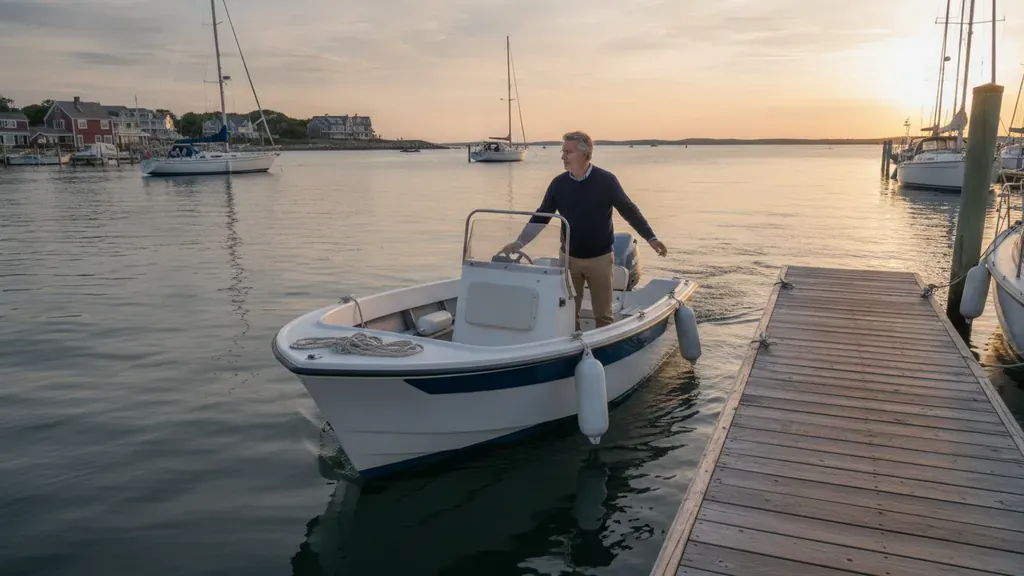
Different hulls and propulsion systems behave differently at the dock. Review the boats available in the Carefree fleet and ask which model is best for your experience and planned outing.
What Should You Do If Something Goes Wrong?
Good operators prepare for small problems before they become emergencies. If the engine stops, keep passengers calm, put on life jackets if they are not already being worn, and assess your position, wind, current, and nearby hazards. If it is safe, deploy the anchor to prevent drifting while you contact the appropriate support.
For a life-threatening emergency, use the radio to make a Mayday call and contact emergency services. Give your location, the nature of the problem, the number of people aboard, and the help needed. For a non-life-threatening urgent situation, follow the appropriate radio procedure. A boat’s manual and formal safety course should explain the radio and emergency systems in detail.
Responding to a person overboard
Point continuously at the person in the water and call out so the operator knows the location. Throw flotation if it can be done safely, reduce speed, and keep the propeller away from the person. Do not jump in after them unless you are trained and another person can operate the boat and call for help. Approach only when you have a clear recovery plan.
When should you stop the trip?
Turn around or seek a safe harbor when weather, visibility, mechanical condition, passenger comfort, or your own skill level no longer supports the trip. There is no prize for continuing into conditions you cannot manage. A conservative decision is part of competent boat operation.
How Does Carefree Help Beginners Learn?
Reading about controls helps, but confidence grows through supervised practice. Carefree Boat Club offers on-the-water training for members at different experience levels. Instructors can help you learn the specific boat, practice departures and docking, review radio and safety equipment, and build familiarity with local waterways.
Training can also connect boat handling to real Massachusetts boating decisions: where to slow down, how to read local markers, how wind and current affect a turn, and how to plan an outing that fits your group. The goal is not to rush a new operator into a difficult trip. It is to build repeatable habits so you can make sound decisions on Boston Harbor, the North Shore, and Cape Ann.
Carefree’s on-the-water training program is a practical next step for anyone who wants instruction beyond a written course. Members can also enjoy reciprocal access at 150+ Carefree locations worldwide, giving experienced members more opportunities to apply safe operating habits in new settings while following each area’s rules.
If you are comparing ways to enjoy boating without owning, remember that a boat club does not remove the operator’s responsibility. You still need the required education, a proper lookout, safe judgment, and boat-specific instruction. Carefree’s model, summarized by the phrase “Boating Without Owning,” pairs access to maintained boats with training and support so beginners can learn before taking on more challenging trips.
Book Your Carefree Boat Club Tour Today
What Are the Most Common Questions About Driving a Boat?
Is driving a boat like driving a car?
No. A boat responds to propulsion, wind, current, and waves, and it continues moving after the throttle returns to neutral. Practice at low speed in open water, make small control inputs, and leave more space than you think you need.
Can a beginner learn how to drive a boat?
Yes, many beginners learn through a combination of an approved safety course, boat-specific orientation, and supervised on-water practice. Start with basic controls and calm conditions, then add docking, navigation, and more complex water conditions as your skills improve.
Do I need a boating license in Massachusetts?
Massachusetts uses boater safety education requirements rather than treating a standard driver’s license as permission to operate a motorboat. Under the current phased rules, people born after January 1, 1989, need a valid boater safety certificate to operate a motorboat after April 1, 2026. People born on or before January 1, 1989, must obtain a certificate by April 1, 2028. Review the current Massachusetts boating law summary and the state’s Hanson-Milone Act FAQ for the rules that apply to your situation.
How do you stop a boat?
Reduce power early, return the throttle to neutral when appropriate, and allow the boat’s momentum to decrease. If you need additional stopping power and the situation permits, use reverse gently according to the boat’s operating instructions. Keep watching for traffic and obstacles because a boat does not stop instantly.
What is the safest way to learn docking?
Practice with an instructor or experienced operator in calm conditions and an uncrowded area. Prepare fenders and lines, approach at idle speed, account for wind and current, and be willing to pull away and try again. Never use a person as a bumper or ask someone to jump for the dock.
What should I check before leaving the dock?
Check the forecast and route, life jackets, fuel and engine systems, steering and throttle, communications, safety equipment, lines, fenders, and navigation lights when needed. Brief passengers, confirm the propeller area is clear, and start with the throttle in neutral.
Safe boat operation is a skill built through preparation, repetition, and good judgment. Learn the rules, practice with support, and choose conditions that let you stay in control from departure to return.