
If you are asking, “do you need a boating license in Massachusetts?” the practical answer is usually no traditional license. But many motorboat operators must carry a Massachusetts Boater Safety Certificate under the state’s current education rules. The exact answer depends on your birth date, age, vessel, motor, and any applicable exemption.
Book Your Carefree Boat Club Tour Today
Massachusetts generally does not issue a traditional boating license for adults. Instead, an approved boater safety course and certificate may be required for motorboat operation, depending on the operator’s birth date, age, vessel, supervision, and exemptions. Check the Massachusetts boating law summary for current rules.
That distinction is especially useful for families and new boaters preparing to launch from Boston, Danvers, Gloucester, or other North Shore waters. Before planning a course or outing, review the age and vessel rules, then confirm current requirements with Massachusetts authorities. Understanding those basics starts with separating a traditional license from a Boater Safety Certificate. For a broader overview, read the Massachusetts boating safety and training FAQ.
Do You Need a Boating License in Massachusetts?
Short answer: Massachusetts does not use a single, traditional boating license for adults. Instead, the state requires boater safety education and a Boater Safety Certificate for people operating motorboats, subject to the law’s timing rules, supervision provisions, and other exemptions. If you plan to operate a powered boat on Massachusetts waters, do not assume adulthood satisfies the current requirement.
The distinction matters because people often use “boating license” as shorthand for several different things. A Massachusetts Boater Safety Certificate shows that the operator completed an approved safety course, or otherwise qualified under an accepted credential pathway. It is not the same as a driver’s license, and it does not function as a blanket permission for every type of vessel or situation.
Under the Hanson-Milone Boater Safety Act, the mandatory boater safety education provisions took effect on April 1, 2026. The official Massachusetts Environmental Police FAQ says people born after January 1, 1989, must have a boater safety certificate to operate a motorboat after that date. People born on or before January 1, 1989, must have one by April 1, 2028. The same FAQ says the certificate must be on board and available for inspection. The operator may be directly supervised by someone with a certificate or qualify for another exemption. Read the official Hanson-Milone Act FAQ for the current wording and exceptions.
The requirement is focused on motorboats. Massachusetts defines a motorboat as a vessel propelled by machinery, even when machinery is not the vessel’s main or only means of propulsion. A non-motorized vessel, such as a boat propelled only by paddles or oars, is not covered by the motorboat certificate requirement described above. The official FAQ also addresses special vessel categories, so check the current rule before relying on a general assumption. U.S. Coast Guard-documented vessels may be treated differently under the state definition.
Age-specific rules also apply. No person under 12 may operate a motorboat. A person ages 12 through 15 may operate one alone after successfully completing a state-approved boating safety course. Operators under 16 must complete an approved course to operate a vessel with more than 25 horsepower, and personal watercraft operators must be at least 16. These rules are summarized by the Commonwealth in its Massachusetts boating law summary.
Because laws, deadlines, and exemptions can change, verify your situation directly with Mass.gov or the Massachusetts Environmental Police before operating a boat. A safety course is a practical starting point, but only the current official requirements determine whether your certificate, age, vessel, and supervision arrangement are sufficient.
Who Must Complete a Massachusetts Boating Safety Course for a Boating License?
Massachusetts age rules do not create one simple answer for every boat operator. The answer depends on the operator’s age, the type of vessel, and the vessel’s horsepower. A boating safety course certificate is different from a traditional boating license. The rules below explain when course completion is required for younger operators, while the state boating rules remain the final authority.
Under Massachusetts law, no person under 12 years of age may operate a motorboat. This is an age minimum for operating the motorboat, not a statement that a child under 12 can meet the rule by completing a course. A course certificate does not lower that minimum age. The rule is summarized in the official Massachusetts boating law summary.
| Operator or vessel situation | What the rule means |
|---|---|
| Under 12 | May not operate a motorboat. |
| Age 12 through 15 | May operate a motorboat alone after successfully completing a state-approved boating safety course. |
| Under 16 on a vessel above 25 horsepower | Must complete a boating safety course to operate the vessel. |
| Personal watercraft operator | Must be at least 16 years old. |
The ages 12 through 15 rule and the under-16 horsepower rule can overlap, but they are not identical. For example, a 15-year-old is within the 12-through-15 age group and must complete an approved course before operating a motorboat alone. If that operator is using a vessel with more than 25 horsepower, the separate horsepower rule also applies because the operator is under 16. Treat both age and vessel specifications as part of the planning check.
Personal watercraft, often called PWCs, have their own minimum age rule. An operator must be at least 16 years old. Completing a boating safety course does not change that minimum age. In other words, a course certificate is not a substitute for meeting the PWC age requirement.
These rules address when a course is required and whether an operator may use a particular vessel. They do not mean that a course is unnecessary for older boaters. Approved safety education can help every operator understand navigation rules, emergency procedures, and equipment requirements. It can also make a first trip more comfortable, especially for families boating from Boston, Danvers, Gloucester, the North Shore, or Cape Ann.
Before heading out, confirm the current requirements with Massachusetts authorities and verify that the course you choose is approved for the education requirement that applies to you. Keep your course certificate available while boating if you have completed one. Ask the course provider or state authority about any situation that does not fit these basic categories.
What Changed Under the 2026 Massachusetts Boating Safety Law?
Massachusetts is changing its boating safety education requirements through the Hanson-Milone Boater Safety Act. The law does not turn a boater safety certificate into a traditional driver’s-license-style boating license. Instead, it creates a certificate requirement for many people who operate motorboats in Massachusetts. The official state FAQ is the best source for the rollout timeline, age rules, and exceptions.
The Hanson-Milone Act was signed into law in January 2025. Its mandatory boater safety education provisions take effect on April 1, 2026. The timing is based on the operator’s birth date, so two adults using the same motorboat may have different deadlines for completing the education requirement.
- People born after January 1, 1989, must have a boater safety certificate to operate a motorboat after April 1, 2026.
- People born on or before January 1, 1989, must have a boater safety certificate to operate a motorboat by April 1, 2028.
Under the Massachusetts Environmental Police FAQ, anyone who wants to operate a motorboat in Massachusetts must have a boating safety certificate on board and available for inspection. The exception applies when that person is operating under the direct supervision of someone who has a certificate or is otherwise exempt. The direct supervision exception should be understood exactly as the official FAQ describes it. Do not assume that informal advice from another boater, a general orientation, or simply having a certificate somewhere at home answers every compliance question.
This requirement applies to motorboats, meaning vessels propelled by machinery, even when the motor is not the vessel’s only source of propulsion. The FAQ also addresses related categories, including personal watercraft and sailboats with motors. Those rules can involve separate age or credential requirements, so check the category that matches the vessel you plan to operate.
Completing an approved boater safety course is the practical path to obtaining the certificate. A course is different from a general boating license. Carefree Boat Club orientation should not be treated as a substitute for a Massachusetts certificate unless the state specifically recognizes it for that purpose. If you are preparing to boat from Boston, Danvers, Gloucester, or another Massachusetts harbor, review the current requirements before your first trip.
Dates and implementation details can change as agencies update guidance. Before relying on this summary, verify the current information in the official Hanson-Milone Act FAQ and related Massachusetts boating law resources. Confirm your birth-date deadline, course eligibility, certificate status, and any applicable exemption directly with Massachusetts authorities.
How Do You Complete an Approved Boating Safety Course in Massachusetts?
Completing an approved boating safety course is the practical path to earning a Massachusetts Boater Safety Certificate. The certificate is different from a traditional driver’s license for a boat, and the exact requirement can depend on your age, birth date, vessel, and existing credentials. Start with current guidance from the Massachusetts Environmental Police, then keep documentation of what you complete. The broader Massachusetts boating safety, licensing, and training resources can help you continue learning after the course.
The process is straightforward, but approval matters. Use this sequence to choose a valid course and protect yourself from assuming that any online class or informal orientation meets the state’s education requirement.
- Find an approved provider. Begin with the state’s boating safety course directory and identify a provider or partner program that is currently approved. Massachusetts offers courses through local organizations and online platforms. If you are comparing online options, review this guide to taking a boating safety course, then confirm the specific program’s current recognition before enrolling.
- Complete the instruction. Work through every required lesson rather than jumping directly to an assessment. Approved boating education commonly covers navigation rules, emergency procedures, required equipment, safe operating habits, and responsible use of waterways. Pay particular attention to material for Massachusetts waters. This includes local navigation expectations near Boston, Danvers, Gloucester, the North Shore, or Cape Ann.
- Finish the assessment or other completion requirements. Follow the provider’s instructions for quizzes, an exam, attendance, identity checks, or any other required steps. Do not treat a course as complete until the provider confirms that you have successfully met its requirements. A passing result is what supports issuance of the course certificate.
- Obtain and retain your certificate. Save the certificate as soon as it is issued. Keep a reliable digital copy and a printed copy, and follow Massachusetts guidance recommending that boaters carry the Boating Safety Course Certificate while on the water. The certificate should be available for inspection when required.
- Verify an existing credential before skipping the course. Some USCG or out-of-state credentials may qualify for recognition without completing a full Massachusetts course. Do not assume yours qualifies. Confirm eligibility with the current state guidance or an approved program, using this Massachusetts boating course overview as a starting point for questions to ask.
Carefree Boat Club training and orientation can help members learn safe operation and local conditions, but orientation should not be represented as an automatic government certificate. If you plan to operate a motorboat through Carefree, independently confirm that you hold any Boater Safety Certificate required for your circumstances. Rules and implementation details can change, so check the latest Massachusetts guidance before your first trip and retain proof of completion for the season.
Do You Need a Boating License in Massachusetts Before Leaving the Dock?
Completing a boating safety course is only the starting point. Before leaving a Massachusetts dock, make a short departure check part of every trip. The operator should confirm that required safety equipment is aboard, everyone knows where it is, and the planned route matches the weather and the crew’s experience. Massachusetts guidance also stresses that operators remain responsible for safe decisions on the water, even when they are familiar with a boat.
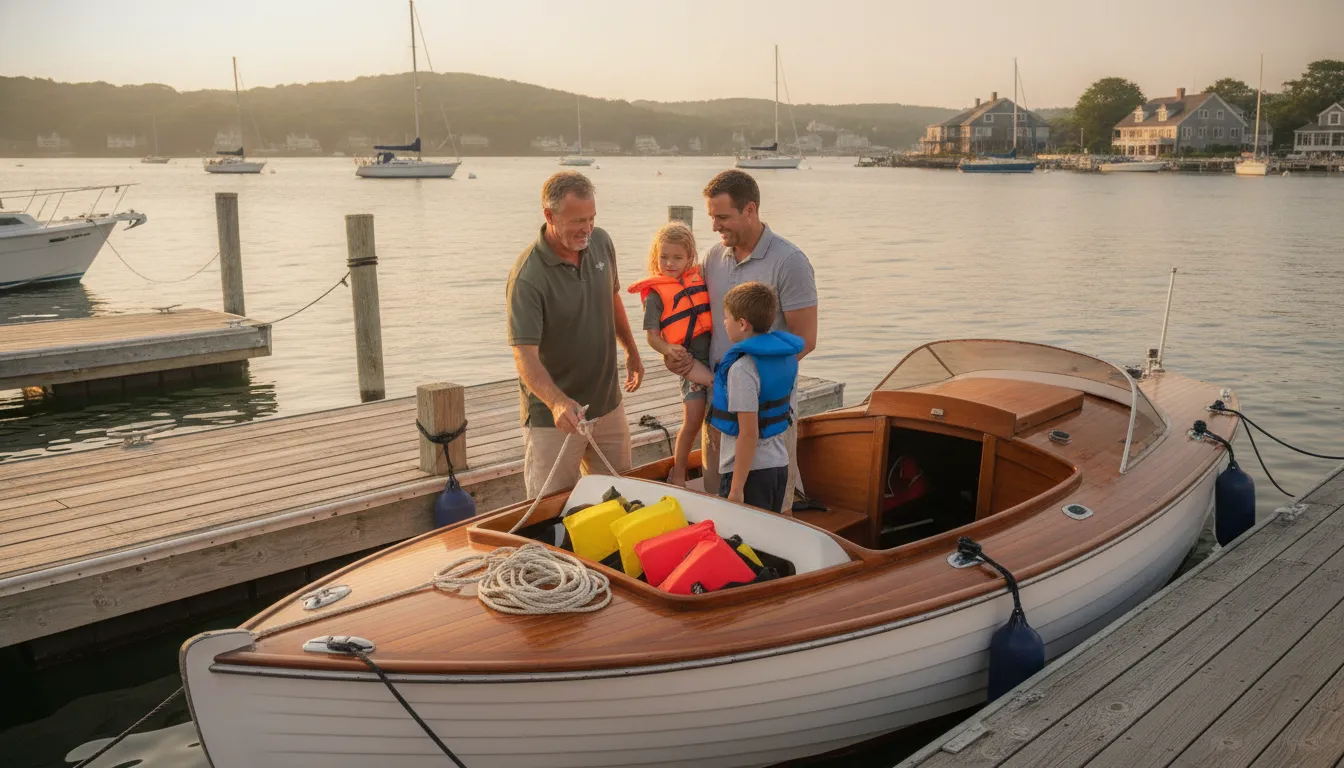
Start with life jackets. Carry a properly fitted, US Coast Guard-approved life jacket for every person aboard, and make sure children under 12 wear one while onboard any vessel. Inspect jackets for damage and choose styles suited to the activity. Next, check signaling equipment. Depending on the vessel and trip, Massachusetts requirements may include devices such as a whistle or flares. Keep required equipment accessible, not packed beneath loose gear, and know how to use it before an emergency.
Stay sober at the helm. Operating a vessel under the influence of alcohol or drugs is illegal and can bring severe penalties. Assign a sober operator before departure, and do not assume calm water or a familiar route makes impairment safe. Review the forecast before casting off, then continue monitoring weather during the trip. Wind, visibility, thunderstorms, and changing conditions can make a return more difficult than the outbound run.
Know the navigation rules and treat them as the water’s rules of the road. Maintain a proper lookout at all times, scan ahead and to the sides, and avoid distractions. Give other boats, swimmers, paddlecraft, and fixed objects enough room. Follow posted speed limits and slow to an appropriate speed in marked no-wake zones. A no-wake area is not merely a suggestion. Excessive wake can endanger people, damage docks, and create conflicts in busy waterways.
Finally, learn the hazards specific to the route. In Boston Harbor and along the North Shore and Cape Ann, review charts and local notices for shoals. Rocks, narrow channels, tidal currents, commercial traffic, and restricted or congested areas. Massachusetts advises operators to understand local water conditions and hazards before operating. A route-specific review is especially valuable when conditions, tide, or visibility change. For more route-planning context, use this Boston Harbor boating guide, then make the final go or no-go decision based on current conditions and the official Massachusetts boating law summary.
How Can Carefree Boat Club Members Prepare for Safe Local Boating?
Carefree Boat Club helps members build confidence before they take the helm. The experience is designed for people who want the enjoyment of boating without owning, storing, cleaning, and maintaining a boat themselves. That convenience does not remove the need for preparation. Safe boating starts with learning the vessel, reviewing local conditions, and understanding the rules that apply to every trip.
Before operating a boat, members receive orientation covering the controls, handling, safety equipment, departure procedures, and return process. Training can also focus on practical habits such as checking the weather, keeping a proper lookout, communicating with passengers, and responding calmly to changing conditions. New boaters should use this time to ask questions and practice at a comfortable pace. Experienced boaters benefit from the same local review because familiarity with one waterway does not guarantee familiarity with another. Prospects can also review the Carefree boat fleet while considering which type of boating experience fits their plans.
Local-waterway preparation matters across the Carefree locations in Boston, Danvers, and Gloucester. Boston Harbor brings busy channels, changing traffic, and varied shoreline conditions. Danvers and the North Shore require attention to tides, marked channels, rocks, and other navigational hazards. Gloucester and Cape Ann can present open-water conditions that change quickly with wind and weather. Orientation helps members connect general boating skills with the waters they are most likely to visit. Operators should still study their planned route and remain alert throughout the trip.
Members remain responsible for understanding and complying with Massachusetts law. Club orientation is not automatically a government-issued certificate. And it does not by itself replace any state-approved boating safety course or other requirement that may apply to the operator, age, vessel, or activity. Review the current Massachusetts boating law and confirm requirements with the appropriate state authority before going on the water. Keep any required documentation available, and ask the club team if you need help identifying preparation steps.
This model makes it easier to keep learning while enjoying access to Carefree boats without the responsibilities of ownership. Members may also receive reciprocal access at 150+ participating locations worldwide, so the same safety-first habits can support boating in new destinations. Whether you are preparing for a short trip from Boston or planning a day from Gloucester. Take the time to review the boat, route, weather, equipment, and applicable regulations before departure. To understand how boating without ownership works, explore Carefree membership.
Book Your Carefree Boat Club Tour Today
Frequently Asked Questions About Massachusetts Boating Licenses
Do you need a boating license in Massachusetts?
Massachusetts does not issue a general traditional boating license for adults. However, the Hanson-Milone Boater Safety Act establishes boater safety education requirements for motorboat operators. Depending on the applicable date, you may need a boater safety certificate on board and available for inspection. Check the latest requirements on Mass.gov before operating.
Who needs a Massachusetts boater safety certificate?
Anyone who operates a motorboat in Massachusetts generally must have a boater safety certificate available for inspection. Unless an exemption applies or the operator is directly supervised by someone with a certificate. The requirement concerns motorboats, meaning vessels propelled by machinery. Rules can differ for non-motorized vessels and specific vessel types, so confirm your situation with the Massachusetts Environmental Police.
When does the new Massachusetts boating safety law take effect in 2026?
The boater safety education provisions of the Hanson-Milone Act take effect on April 1, 2026. People born after January 1, 1989, must have a boater safety certificate to operate a motorboat after that date. People born on or before January 1, 1989, must have a certificate by April 1, 2028. These dates are based on the current Mass.gov FAQ and should be verified for updates.
What is the minimum age to operate a motorboat in Massachusetts?
No person under 12 may operate a motorboat. A person ages 12 through 15 may operate a motorboat alone after successfully completing a state-approved boating safety course. Operators under 16 must complete an approved course to operate a vessel with more than 25 horsepower. Personal watercraft operators must be at least 16 years old.
Can you take a Massachusetts boating safety course online?
Yes. Mass.gov says boating safety courses are available through local organizations and online platforms. To obtain a certificate, complete a course offered by the Massachusetts Environmental Police or an approved partner program, and confirm that the course is recognized before enrolling. Keep your certificate available while boating, and verify current course and documentation requirements with Massachusetts authorities.
For current rules, review the Massachusetts boating law summary and the Hanson-Milone Act FAQ.
Ready to Learn More About Boating in Massachusetts?
Curious what a better boating routine could look like in Massachusetts? Carefree Boat Club makes it easier to spend more time on the water and less time managing the details of boat ownership. Start with a conversation about your goals, experience, and favorite ways to enjoy the coast.
Local prospects can ask about membership, training, and boating from Boston, Danvers, or Gloucester. Whether you are new to boating or looking for a more flexible way to enjoy time on the water, the team can explain how the club works and what to expect. Members also receive reciprocal access at 150+ participating locations nationwide, creating more opportunities to boat while traveling.